
7 Bleed Control Kit Rules Every Workplace Should Know
Last Updated: October 26, 2026
Quick Summary
No, a bleed control kit is not named in any Australian work health and safety law. However, the general duty of care requires employers to provide first aid equipment, and your first aid risk assessment decides whether a bleed control kit is reasonably practicable for your site.
- The model WHS Regulations require first aid equipment to be provided and accessible, but leave the contents to you.
- The first aid code of practice requires a risk-based approach and points to hazards that cause severe bleeding.
- Run a four-step risk assessment: list hazards, rate likelihood and severity, check ambulance distance, then match equipment.
- The PCBU must fund, maintain and ensure access to the kit, and delegation does not transfer the legal duty.
- Check the kit monthly, replace expired items, and restock immediately after any use.
Table of Contents
- Are Bleed Control Kits Required by Law in Australian Workplaces?
- Legal Requirements for First Aid Kits in Australia: What the Code Says
- Workplace First Aid Risk Assessment: How It Decides If You Need a Kit
- Bleed Control Kit Contents: What Should Be Inside
- Who Is Responsible for Providing and Funding a Kit
- First Aid Kit Maintenance and Inspection: Keeping a Kit Ready
- Choosing a Bleed Control Kit for Your Workplace
- Frequently Asked Questions
Are Bleed Control Kits Required by Law in Australian Workplaces?
No, a bleed control kit is not named in any Australian work health and safety law.
Here is the part most guides get wrong.
The bleed control kit question is really a risk management question. Work health and safety law sets a general duty.
Below, we break down the law, the code of practice, and the practical steps that keep you covered.
What the WHS Act and Regulations Actually Say
The primary law is the model Work Health and Safety Act and Regulations, plus each state and territory's own version.
What they do set is a general duty of care. An employer must provide first aid equipment and access to first aid facilities.
The model Work Health and Safety Regulations require first aid equipment to be provided and made accessible.
That is the gap. The law tells you to provide first aid.
Where the Duty of Care Comes From
Duty of care comes from the general obligation to protect workers and others from harm, so far as is reasonably practicable.
"Reasonably practicable" means weighing the risk against the cost of controlling it.
So the duty is not "buy a bleed control kit". The duty is "control the bleeding risk your workplace actually creates".
That framing changes everything about how you justify the purchase.
Legal Requirements for First Aid Kits in Australia: What the Code Says
The Work Health and Safety Code of Practice on first aid in the workplace is the practical guide that sits under the law.
The code does not mandate a bleed control kit by name.
In practice, that means the code expects you to think about trauma. A kit is one way to meet that expectation.
The code is not law on its own. But courts and regulators treat it as evidence of what a reasonable employer would do.
Workplace First Aid Risk Assessment: How It Decides If You Need a Kit
A workplace first aid risk assessment is the process of matching your first aid equipment to the hazards your workers actually face. It is the document that decides whether a bleed control kit is optional or necessary.
Run it in four steps:
- List the hazards that could cause severe bleeding on your site
- Rate the likelihood and severity of each one
- Check the distance to emergency services and ambulance response
The last step matters most. Write down why you chose the kit you chose. If an incident ever happens, that record shows you thought it through.
Hazards That Push a Bleed Control Kit From Optional to Necessary
Some hazards make a kit hard to argue against. If your site has any of these, the case is strong.
- Powered tools, saws, presses, or cutting equipment
- Work at height, with fall and impact risk
- Vehicles, forklifts, or moving plant
Construction sites carry a mix of these risks, and the sector-specific guidance on first aid kits for construction sites helps you judge your exposure.
The common thread is time. A severe bleed can become life-threatening in minutes. If help is far away, the kit buys time.
Bleed Control Kit Contents: What Should Be Inside
A bleed control kit should contain the tools to stop severe bleeding fast: a tourniquet, a trauma or pressure dressing, gloves, shears, and a marker for recording time.
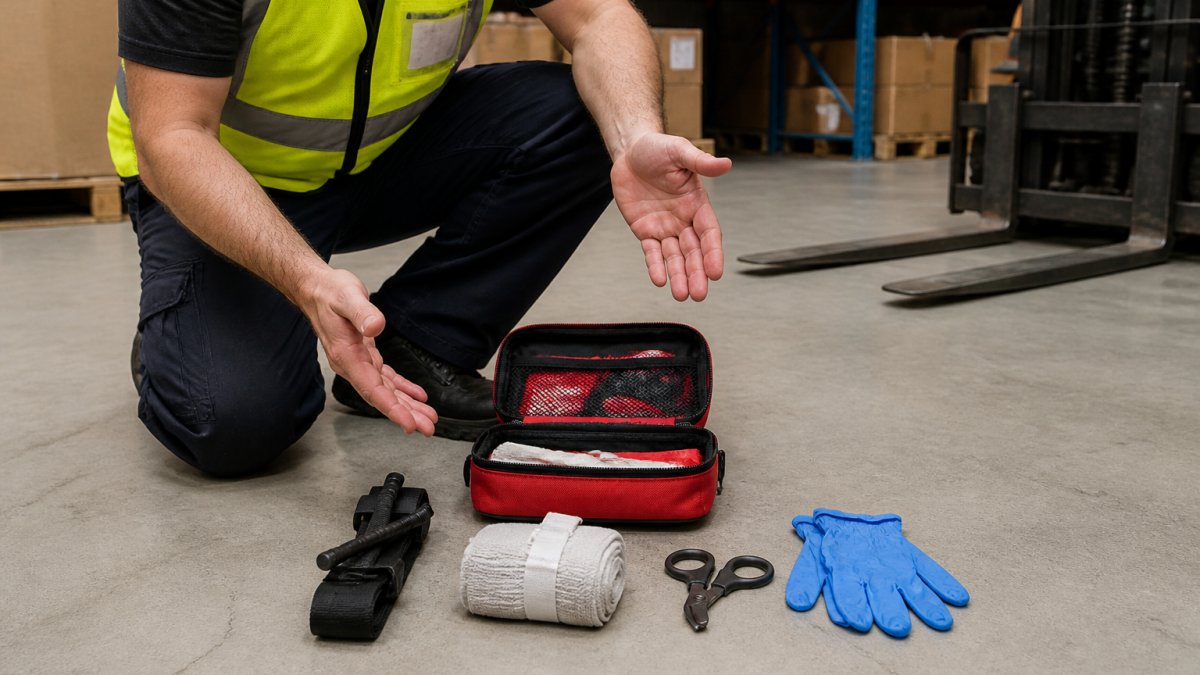
Here is what each item does:
- Tourniquet: cuts off blood flow to a limb when direct pressure fails
- Trauma or pressure dressing: holds firm pressure on a wound
- Nitrile gloves: protect the responder and the casualty
For a deeper breakdown of component choices, see the guide to the best bleed control kit components.
RAPIDSTOP Medium Bleed Control Pack with QUIKCLOT Combat Gauze →
Watch out: buying a kit without training in tourniquet use can do more harm than good. The kit is only as good as the person using it.
Who Is Responsible for Providing and Funding a Kit
The duty to provide first aid equipment, including any bleed control kit, sits with the person conducting the business or undertaking (PCBU). That is the statutory language, and it is broader than "employer".
But "PCBU" is not the whole answer, because the same question produces different answers depending on who is asking. Here is how the responsibility splits across the groups most likely to search for this.
Employers and PCBUs
The PCBU must provide the equipment, fund it, maintain it and ensure workers can access it. In practice that means:
- The business pays for the kit and its restocking
- A named person owns inspection and maintenance
- Workers are trained and told where the kit lives
For a small construction firm, the owner carries that duty personally. For a larger manufacturer, it may be delegated to a WHS officer, but delegation does not transfer the legal duty. The PCBU remains accountable.
Schools and education providers
Schools are PCBUs in their own right, and they also owe duties to students and visitors who are not workers. A school's first aid risk assessment should consider hazards such as science laboratories, technology workshops, sports facilities and playgrounds. Where those hazards create a severe bleeding risk, a bleed control kit may be a reasonably practicable control, but the decision should be documented in the school's first aid policy rather than assumed.
Event organisers
An event organiser is a PCBU for the duration of the event, and the duty extends to attendees, contractors and volunteers. Large events with crowds, vehicles, temporary structures or high-risk activities (motor sport, equestrian, construction demonstrations) face a stronger case for trauma-capable first aid than a low-risk community fete. The event's emergency management plan is the natural place to record the decision.
Property owners and facility managers
A property owner who leases space to a business is not usually the PCBU for that business's activities, but they may be a PCBU for shared areas, lobbies, car parks, loading docks, shared workshops. Where the shared area creates a bleeding hazard, the owner or facility manager may carry a duty to provide first aid equipment in that area. This is the boundary most often missed in multi-tenant buildings.
Members of the public
A member of the public has no statutory duty to carry a bleed control kit. Good Samaritan protections in each state and territory generally protect a person who gives reasonable assistance in an emergency from civil liability, but those protections do not create an obligation to carry equipment. A kit in a personal vehicle or home is voluntary preparedness, not legal compliance.
Funding: who pays, and can it be shared?
Funding follows the duty. The PCBU pays. In multi-tenant or shared-site arrangements, cost-sharing is possible by agreement, but the legal duty is not diluted by a cost-sharing arrangement, each PCBU remains responsible for the first aid equipment needed for the risks it creates or controls. A written agreement that allocates responsibility for shared kits is good practice, but it does not override the statutory duty.
What good delegation looks like
Delegation is a management tool, not a legal transfer. A workable pattern is:
- The PCBU retains accountability and signs off the first aid risk assessment
- A named officer owns inspection, restocking and training records
- The kit's location and contents are recorded in the emergency plan
That structure gives a regulator a clear paper trail showing the duty was turned into action, which is what the general duty ultimately requires.
First Aid Kit Maintenance and Inspection: Keeping a Kit Ready
A bleed control kit needs regular inspection and maintenance so it works when someone needs it. Check it monthly, restock anything used, and replace items before they expire.
Use this simple routine:
- Check the tourniquet and dressings are present and sealed
- Confirm gloves are intact and in date
- Replace any expired item
The expiry date is the item most often missed. A kit that looks full can still be useless if the dressings are out of date.
For a full maintenance routine, see the guide on how to maintain workplace first aid kits.
Choosing a Bleed Control Kit for Your Workplace
Choose a bleed control kit by matching its size and contents to your risk assessment, not by buying the biggest option.
At PFA Shop, we stock the RapidStop range, which covers both ends of that scale.
Kit |
Price (AUD) |
Best For |
|---|---|---|
RapidStop Small Bleed Control Pack |
$89.99 |
Small teams, vehicles, low-risk sites |
RapidStop Small Bleed Control Pack with QUIKCLOT Combat Gauze |
$179.99 |
Small teams wanting added haemostatic gauze |
RapidStop Medium Bleed Control Pack |
$139.99 |
Workshops, warehouses, mid-size sites |
RapidStop Medium Bleed Control Pack with QUIKCLOT Combat Gauze |
$219.99 |
High-risk sites and remote work |
Each pack includes a tourniquet, a trauma control bandage, universal shears, nitrile gloves and a fine-tip marker.
Best for: safety officers who want a compact, restockable kit. Skip if: you need a full first aid station rather than a bleeding-specific pack.
To compare the wider range of advanced trauma kits for workplaces, or to view the RAPIDSTOP Medium Bleed Control Pack itself, the product pages show the full contents.

Frequently Asked Questions
Are bleed control kits mandatory in Australian workplaces?
No blanket rule makes a bleed control kit mandatory in every workplace. The Work Health and Safety Regulations require first aid equipment and facilities that are adequate for the hazards at your site, and the model Code of Practice on first aid in the workplace sets out how to work that out. If your workplace first aid risk assessment identifies serious bleeding hazards, such as machinery, cutting tools, vehicles or high-risk construction work, a bleed control kit becomes a reasonable control and should be provided. Document the assessment so you can show why you did or did not include one.
What is legally required in a first aid kit?
The regulations do not list exact contents. They require first aid equipment and supplies appropriate to the hazards and the number of workers, and the model Code of Practice gives guidance on typical contents. General kits usually hold dressings, bandages, adhesive strips, gloves, eye pads, saline and a resuscitation mask. A bleed control kit goes further, with a tourniquet, trauma bandage, shears, gloves and a marker for recording tourniquet time. Check the regulator guidance that applies in your state or territory, because details vary.
Who is responsible for maintaining workplace first aid supplies?
The person conducting the business or undertaking holds the duty under work health and safety law, but day-to-day checking is usually assigned to a nominated first aider or safety officer. Name that person in your procedures and give them a schedule: check the kit monthly, confirm stock levels after any incident, and replace anything past its expiry date. Keep a simple log of inspections. If a kit is found empty or expired during an incident, that log is the difference between a documented system and an obvious gap.
What should a workplace bleed control kit contain?
A practical kit includes a tourniquet for limb bleeding when direct pressure fails, a trauma or pressure bandage for firm compression, wound packing gauze, shears to cut clothing, nitrile gloves and a marker for noting tourniquet time. The RapidStop Medium Bleed Control Pack with QUIKCLOT Combat Gauze at $219.99 covers that workflow in a compact pouch, and smaller versions start at $89.99. Match the kit to your risk assessment, then check contents against the manufacturer's list each time you inspect.
The law will not hand you a checklist for severe bleeding. Your risk assessment has to do that work. PFA Shop stocks compact, purpose-built bleed control packs, with the RapidStop tourniquet, trauma dressings and clear contents for fast response. Get started with PFA Shop and give your workplace a kit that is ready when minutes matter.
