
How to Maintain Workplace First Aid Kits: 2026 Guide
Table of Contents
- How to Maintain Workplace First Aid Kits: The Monthly Routine
- Workplace First Aid Kit Checklist: What to Check Every Month
- How Often to Check a First Aid Kit (and When to Review It)
- Restocking, Expiry Dates and Disposal: Replacing What's Used
- Using a First Aid Kit Inspection Log and Assigning Ownership
- How to Store Medical Supplies Safely and Keep Kits Accessible
- Frequently Asked Questions
Last Updated: October 16, 2026
How to Maintain Workplace First Aid Kits: The Monthly Routine
Learning how to maintain workplace first aid kits comes down to one habit: a short, regular check. A workplace first aid kit is a stocked, in-date set of medical supplies kept on site so injuries can be treated quickly while waiting for professional help.

That is when people find a kit full of empty packets and dried-out wipes.
Below, we break down the monthly routine, what to check, how often to review, and how to keep the whole system running when staff move on. It takes about 15 minutes a month.
What You'll Need Before You Start
Gather these before you open the kit:
- A printed workplace first aid kit checklist
- A pen and the kit's inspection log
- A bin bag for expired or damaged items
- Replacement stock, such as a COMMANDER 6 Series First Aid Kit Refill
- Gloves, so you are not handling used supplies bare-handed
Keep the log with the kit. If it lives in a drawer somewhere else, it will not get filled in.
Workplace First Aid Kit Checklist: What to Check Every Month
Work out what is missing, what has expired, and what is damaged, then write it down. That is the whole monthly check.
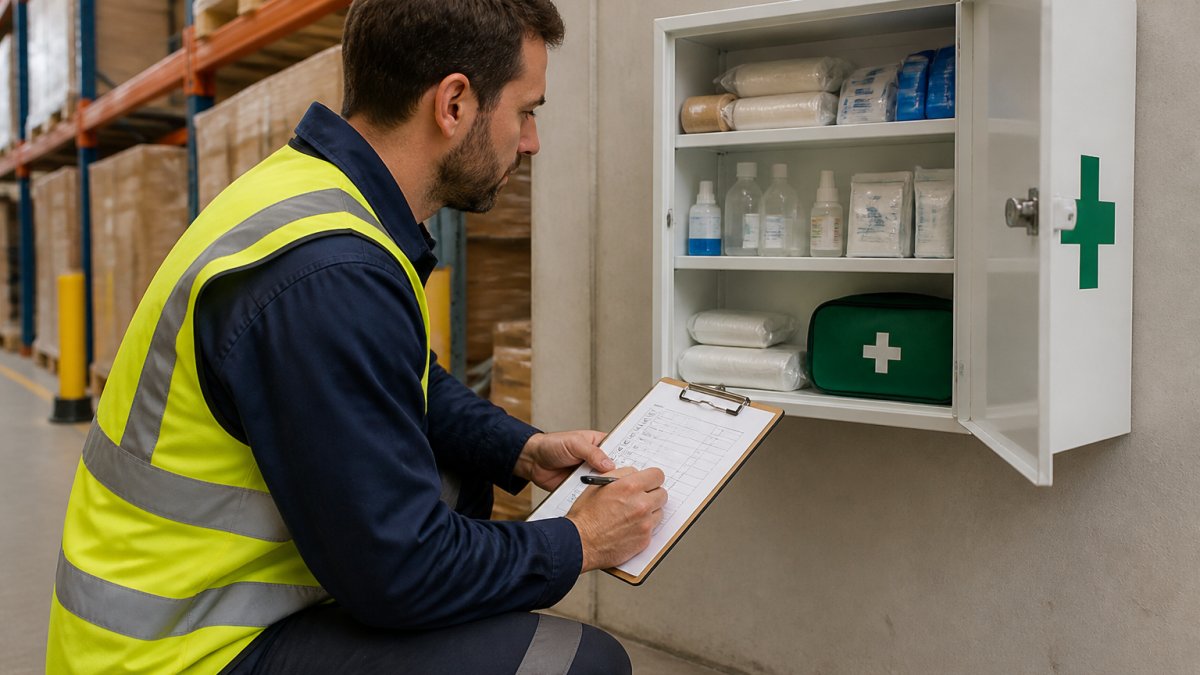
Work through the kit in this order:
- Stock levels: count dressings, bandages, plasters and gloves against the list
- Expiry dates: check every sterile item, wipe and ampoule
- Damaged supplies: look for torn packaging, cracked ampoules and rusted instruments
- Missing items: shears, forceps and CPR charts walk off more often than you would think
- Signage: confirm the kit is clearly marked and the CPR chart is current
- Case condition: check seals, hinges and latches
How Often to Check a First Aid Kit (and When to Review It)
A monthly check is the baseline for most workplaces, with a full review once a year. High-risk sites and busy kits need more.
Match the frequency to your risk level and how often the kit gets used:
Workplace Type |
Check Frequency |
Full Review |
|---|---|---|
Office, low risk |
Monthly |
Yearly |
Warehouse, workshop |
Monthly |
Yearly |
Construction, manufacturing |
Weekly to monthly |
Yearly |
Marine, outdoor, remote |
Before each trip or shift |
Yearly |
Usage drives this more than anything else. A kit that gets opened twice a week should be checked twice a week, whatever the calendar says. After any incident, restock before the kit goes back on the wall.
The yearly review is also when you re-check your Safe Work Australia first aid code of practice obligations against your risk assessment. Staff numbers change, hazards change, and your kit count should follow.
Restocking, Expiry Dates and Disposal: Replacing What's Used
Replace used, missing and expired items straight away, and dispose of anything past its date or damaged. Do not wait for the next scheduled check.
A simple rule: if it is gone, expired or broken, it comes out today.
What to do with each type of item
Most guides stop at 'discard and replace'. The practical question is how, and into what.
- Used supplies: replace immediately after the incident. Anything that touched a person comes out of the kit, even if it looks unused.
- Expired items: remove and bin, even if the packet is sealed. Sterility and adhesive performance degrade past the date, and a sealed packet gives no reassurance.
- Damaged supplies: discard anything with torn, damp or crushed packaging. A dressing that has been wet is no longer sterile, regardless of the expiry date.
- Opened but unused items: if a dressing, wipe or ampoule has been opened, it does not go back in the kit. This is the single most common cause of a kit failing an inspection.
- Contaminated items: follow your site's clinical waste rules. In most workplaces this means a sharps container for anything sharp, and a sealed clinical waste bag for anything blood- or body-fluid-stained. Do not put contaminated items in general waste.
- Sharps and glass ampoules: never into a general bin. Use a sharps container, even for a single broken ampoule.
Single items versus full refill kits
For most workplaces, a full refill kit is cheaper and faster than buying items one at a time. The trade-off is straightforward:
- Single items suit a kit that is missing one or two things, or a workplace that uses a lot of one specific item and wants to buy it in bulk.
- Full refill kits suit a kit that has been used heavily, has multiple items approaching expiry, or has just been through its annual review. They restore a depleted kit in one step and remove the risk of forgetting a small item.
A practical pattern is to keep one full refill on the shelf for every two or three kits on site. When a kit is restocked from the refill, the refill is reordered the same day, not when the next kit runs low.
Expiry dates: what to check and when to act
Check every sterile item, wipe and ampoule at each monthly inspection. Flag anything expiring within three months on the log so it can be rotated out before it becomes urgent.
Some items are easy to overlook:
- Adhesive plasters and tapes, where the adhesive fails before the date on the box
- Saline ampoules and eye wash, which are often the first items to expire
- CPR face shields and resuscitation masks, which have their own expiry separate from the kit
- Batteries in any torch or AED stored with the kit
Using a First Aid Kit Inspection Log and Assigning Ownership
A first aid kit inspection log is a written record of every check, who did it, and what was replaced. It is the difference between a kit that works and a kit you hope works.
COMMANDER 6 Series First Aid Kit Refill →
This is the part most guides skip. A log does three things:
- Proves your checks actually happened
- Shows what gets used most, so you can stock smarter
- Survives staff turnover, because the record stays with the kit
What a usable inspection log actually contains
Keep it short enough that people fill it in. A workable log has six fields per line:
Field |
What to record |
|---|---|
Date and time |
When the check happened |
Inspector |
Full name, not initials |
Items checked |
Tick box for stock, expiry, damage, signage, case |
Items replaced |
Item name and quantity |
Expiry noted |
Any item expiring within the next three months |
Action taken |
Restocked, removed, escalated, or no action |
A single A4 page with ten rows covers most kits for a year. Print a fresh sheet each January and keep the old ones, the pattern of what runs out tells you more about your workplace than any generic contents list.
Assigning ownership so it survives leave and turnover
Name one owner and one backup. A kit with no owner gets checked by nobody. Write both names on the log itself, not in a folder somewhere else.
A common pattern in workplaces that keep their kits current:
- The primary owner is the person closest to the kit's location, not the most senior person on site
- The backup is named in writing and knows where the log lives
- Annual leave, sick leave and shift changes are covered by the backup, not by a vague 'someone will do it'
- When the primary owner leaves, the handover checklist includes the log, the kit's location, the refill supplier and the review date
- Multi-site operations name an owner per site, with one person responsible for the overall schedule
Digital reminders and simple inventory tools
A calendar alert on the owner's phone beats a paper schedule every time. Set a recurring monthly reminder, plus a separate annual reminder for the full review.
For workplaces with several kits, a shared spreadsheet or a simple inventory app does two things a paper log cannot: it shows every kit's last check date at a glance, and it flags items approaching expiry across all kits at once. Some sites stick a QR code on the inside of the kit lid that opens the log form on a phone, the check takes the same 15 minutes, but the record is written before the inspector walks away.
How to Store Medical Supplies Safely and Keep Kits Accessible
Store kits in a cool, dry place out of direct sunlight, and make sure they are visible and reachable in seconds. Heat, moisture, dust and contamination ruin supplies faster than time does.
Where kits go wrong:
- Direct sunlight: degrades packaging and adhesive
- Hot vehicles or sheds: cooks sterile items and melts dressings
- Damp areas: rusts instruments and spoils packaging
- Locked cupboards: useless in an emergency
- Behind stacked stock: same problem
Mount the kit at a visible location near where injuries happen, with clear signage. Everyone on site should know where it is without asking.
How do you test accessibility?
Ask a new starter to find and reach the kit without help. If they hesitate, it is not accessible enough. Test it once a quarter, and after any layout change.
For marine and outdoor use, storage matters even more. Salt water and sun destroy standard kits, so choose a case built for it and check it before every trip.
The hard part is not the first check. It is the fiftieth, after the person who set the system up has moved on.
PFA Shop supplies workplace, marine and specialised first aid kits and refills, plus AEDs and professional-grade resuscitation equipment. Our refill ranges cover small sites through to high-risk industrial settings, and each item is clearly labelled for fast checks.
Frequently Asked Questions
How often should workplace first aid kits be checked?
Check every kit at least once a month, and inspect it immediately after any incident where supplies were used. High-risk sites such as construction or manufacturing often need weekly checks because stock moves faster. Also review the whole first aid arrangement annually against your risk assessment and any change in staff numbers. A regular rhythm catches expired items and low stock before an emergency exposes the gap.
What should you check when inspecting a workplace first aid kit?
Work through a set checklist: confirm the kit is complete against its contents list, remove anything past its expiry date, check sterile packaging for tears or moisture damage, test that adhesive dressings still stick, and confirm the CPR chart and first aid instructions are present and legible. Note missing items, then restock before signing off. Record the date, your name and any items replaced in your inspection log so the next check starts from a known baseline.
When should first aid supplies be replaced?
Replace any item that has been used, even partially, plus anything past its expiry date and any sterile product whose packaging is torn, damp or discoloured. Single-use items such as saline ampoules and wipes should be discarded after opening. Rather than buying items one by one, a full refill pack restores the kit to readiness in one step. For example, the RESPONDER 4 Series First Aid Kit Refill at $89.99 suits workplaces of roughly 1-25 people in low to medium risk settings.
How should first aid supplies be stored safely at work?
Keep kits in a cool, dry place away from direct sunlight, heat, moisture and dust, because those conditions degrade dressings, tapes and sterile packaging. Store the kit in a visible, accessible location with clear signage, mounted at a height most staff can reach, and never locked away where nobody can find it during an emergency. Check that the case seals properly after each inspection and that contents stay labelled so the right item is easy to find under pressure.