
First Aid Kits for Construction Sites: 2026 Guide
Table of Contents
- How to Choose First Aid Kits for Construction Sites
- Workplace First Aid Kit Requirements in Australia
- Construction First Aid Kit Contents: What Belongs in the Box
- Construction Site First Aid Kit Checklist by Hazard
- 6 First Aid Kits for Construction Sites Compared
- Workplace First Aid Kit Restocking and Expiry Management
- Conclusion: Matching the Kit to the Site
- Frequently Asked Questions
Last Updated: October 6, 2026
How to Choose First Aid Kits for Construction Sites
Choosing first aid kits for construction sites comes down to three things: the hazards your crew faces, how many workers are on site, and whether the kit can survive its environment.

A common mistake is buying one large kit and leaving it in the site office.
Below: the regulatory baseline, a hazard-by-hazard checklist, six kits compared, and how to keep everything in date.
Workplace First Aid Kit Requirements in Australia
Workplace first aid requirements in Australia are set out in the model Code of Practice on First Aid in the Workplace, published by Safe Work Australia. That code is then given legal force by each state and territory regulator.

The code does not prescribe a fixed contents list. It requires employers to assess risk and provide facilities proportionate to the hazards present.
What the Code of Practice Expects on Site
The code expects employers to identify hazards, assess injury and illness risk, then decide on kits, facilities, first aiders and training, and review when work changes.
Risk Assessment, Worker Numbers and Kit Placement
The code links kit numbers to worker numbers by ratio. A commonly cited benchmark is one kit per 50 people, but that is a starting point, high-risk sites should provide more.
Placement is where most sites get it wrong: kits need rapid access from where people work, not just the site office.
Construction First Aid Kit Contents: What Belongs in the Box
Construction first aid kit contents should cover the injuries construction actually produces: lacerations, crush injuries, eye strikes, burns, and penetrating trauma. A generic home kit will not do, and a basic workplace kit often falls short on trauma control and eye irrigation.
The core categories are wound care, bandages, trauma control, eye irrigation, and responder protection; what changes between sites is quantity and depth.
Bandages, Wound Care and Antiseptic Wipes
Every construction kit needs bandages, adhesive tape, and antiseptic wipes for everyday cuts, grazes, and minor abrasions.
Stock more than you think you need: wound care items are consumed fastest, and a depleted kit is non-compliant. Hold at least double the quantity you expect to use between audits.
- Adhesive dressings in assorted sizes for minor cuts
- Crepe and conforming bandages for sprains and compression
- Antiseptic wipes or solution for cleaning before dressing
Trauma Dressings, Eye Rinse and Emergency Items
Trauma dressings and eye rinse separate a construction kit from a basic workplace kit. Construction carries genuine risk of severe bleeding and eye injury, and both need treatment in the first few minutes, before an ambulance arrives.
- Trauma dressings for large wounds and firm compression
- Haemostatic gauze for wounds that will not stop bleeding with pressure alone
- A tourniquet for catastrophic limb bleeding, stored where a trained responder can reach it fast
For sites with serious bleeding risk, add a dedicated bleed control pack alongside the main kit, so a responder does not search a general kit while a colleague is bleeding.
Matching Contents to the Hazards on Your Site
The contents list above is a baseline. What you add depends on what your crew does:
- Hot works and welding: burn dressings, saline, and a fire blanket. Burns need cooling and covering, not just a dressing.
- Power tools and grinding: eye rinse, eye pads, and extra adhesive dressings. Eye strikes and lacerations are the most frequent injuries in these tasks.
- Structural steel and height work: trauma dressings, haemostatic gauze, and a tourniquet, plus a means of getting the kit to the casualty rather than the casualty to the kit.
If unsure whether your contents are adequate, work backwards from the worst realistic injury on your site and check the kit can stabilise it until help arrives. That test exposes gaps faster than any checklist.
Construction Site First Aid Kit Checklist by Hazard
A construction site first aid kit checklist should be built around your specific hazards, not copied from a template. Here is how we map common construction hazards to the supplies that address them.
Hazard |
Supplies to Stock |
Where to Place the Kit |
|---|---|---|
Cuts and lacerations |
Bandages, adhesive tape, antiseptic wipes, wound dressings |
Near work areas and site entry |
Eye injury from dust or debris |
Eye rinse, eye pads |
At every workstation with power tools |
Burns from hot works |
Burn dressings, saline |
Near welding and grinding zones |
Severe bleeding |
Trauma dressings, tourniquet, haemostatic gauze |
With first aiders and in vehicles |
Sprains and fractures |
Compression bandages, splints |
Site office and crib room |
Snake bite on remote sites |
Snake bite bandages, immobilisation gear |
With field crews and vehicles |
6 First Aid Kits for Construction Sites Compared
1. MODULATOR Waterproof Tough First Aid Kit, $390.00, View product
Our top pick for construction.
2. COMMANDER 6 Series Metal Tough First Aid Kit, $332.15, View product

A wall-mountable metal cabinet for fixed sites.
3. COMMANDER 6 Series Plastic Rugged First Aid Kit, $269.99, View product
MODULATOR Waterproof Tough First Aid 43 x 38 x 15.4cm →
A rugged plastic case that resists dust, splashes, and knocks.
4. COMMANDER 6 Series Softpack Versatile First Aid Kit, $229.99, View product
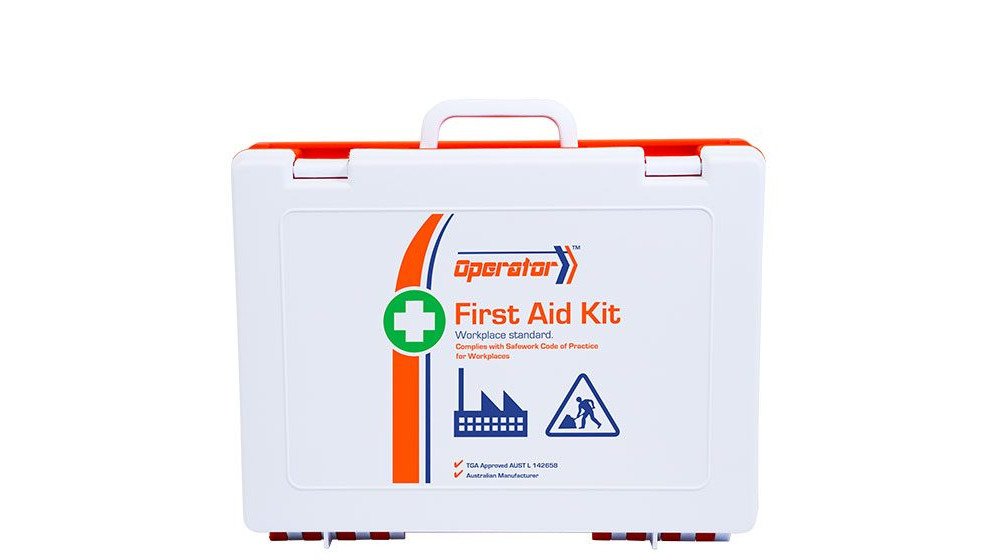
5. OPERATOR 5 Series Plastic Rugged First Aid Kit, $149.99, View product
The budget-conscious choice for smaller crews.
6. RAPIDSTOP Medium Bleed Control Pack, $219.99, View product
Which Kit Fits Which Site
Kit |
Price |
Best For |
Case Type |
|---|---|---|---|
MODULATOR Waterproof Tough |
$390.00 |
Active construction sites |
Waterproof hard case |
COMMANDER 6 Metal Tough |
$332.15 |
Fixed sites, wall mounting |
Metal cabinet |
COMMANDER 6 Plastic Rugged |
$269.99 |
Mobile teams, vehicles |
Rugged plastic |
COMMANDER 6 Softpack |
$229.99 |
Field crews, remote work |
Reinforced softpack |
OPERATOR 5 Plastic Rugged |
$149.99 |
Smaller crews, tight budgets |
Compact plastic |
RAPIDSTOP Bleed Control Pack |
$219.99 |
High-risk sites, alongside main kit |
Plastic pack |
For eye hazards specifically, the AEROWASH Gravity Eyewash Station 30L at $460.00 delivers roughly 15 minutes of continuous flow from a gravity-fed reservoir, with no plumbing required, ideal for temporary and remote sites. For sites near live electrical equipment, the REGULATOR Low Voltage Rescue Kit at $275.00 brings together insulating gloves, a rescue hook, fire blanket, and trauma dressing in a high-visibility grab-and-go bag.
Workplace First Aid Kit Restocking and Expiry Management
Workplace first aid kit restocking is the part everyone plans for and nobody maintains. A kit compliant at handover can be non-compliant within weeks if items are used and not replaced.
The fix is simple: assign one person, set a review interval, and use refill pouches that make restocking fast rather than a full unpack. Most sites that fail an audit did not buy the wrong kit, nobody owned it after installation.
A Repeatable Inspection Schedule
A workable schedule has three tiers:
- Monthly visual check: confirm the kit is present, sealed or closed, and that the external label is legible. Check that no module or pouch is obviously empty. This takes a few minutes per kit.
- Quarterly contents audit: open the kit and check every item against the contents list. Confirm quantities, look for damaged packaging, and check use-by dates on sterile items, saline, and antiseptic.
- Annual full review: reassess whether the kit still matches the site's hazards, worker numbers, and layout. A site that has moved from fit-out to structural work needs a different kit profile, even if the old kit is fully stocked.
Record each check with a date, the checker's name, and any items replaced. A log sheet inside the kit lid is enough, and gives an inspector a clear maintenance trail.
Expiry Dates and What Actually Expires
Not everything in a first aid kit expires, but the items that do matter most in an emergency. Sterile dressings, saline, antiseptic, haemostatic gauze, and some burn dressings carry use-by dates. An out-of-date sterile dressing is not sterile, and expired saline may not be safe on an open wound.
- Check dates on every sterile item at each quarterly audit
- Replace expired items immediately, not at the next audit
- Rotate stock so older items are used first where practical
Restocking Without Unpacking the Whole Kit
Refill systems are the difference between a kit that stays compliant and one that quietly degrades. The Commander 6 Series and MODULATOR ranges take refill pouches that slot into each case and present products through a centre-slit pocket, speeding response and restocking: a responder pulls the pouch, uses what is needed, and the pouch is replaced as a unit.
- Use refill pouches matched to each module or section
- Keep a small stock of spare refill pouches on site or in the vehicle
- Log every item used, including during training, so restocking is triggered before the next audit
A kit is only compliant on the day it is checked. Build the inspection, the refill process, and the record-keeping into someone's role, and compliance becomes a routine rather than a scramble before an audit.
Conclusion: Matching the Kit to the Site
The hard part is not buying a kit. It is matching one to a site that changes shape every few weeks, keeping it stocked, and proving it when an inspector asks.
At PFA Shop, we stock kits built for that reality: the MODULATOR with colour-coded modules and a waterproof tough case, the Commander 6 Series with Surefill refill compatibility, and the RAPIDSTOP bleed control pack for sites where severe bleeding is a genuine risk. We also carry the AEROWASH Gravity Eyewash Station and the REGULATOR Low Voltage Rescue Kit.
Get started with PFA Shop and build a first aid setup that holds up on site, in the vehicle, and under audit.
Frequently Asked Questions
What type of first aid kit do I need for a construction site?
It depends on worker numbers and hazards. A standard workplace kit suits low-risk tasks and small crews, while high-risk sites need added trauma dressings, a bleed control pack and eye rinse. The MODULATOR Waterproof Tough First Aid Kit ($390.00) covers six injury categories in colour-coded modules and suits harsh, dusty environments. Match the kit to your risk assessment, not just your headcount.
What are the essential items in construction first aid kit contents?
At minimum you need dressings, bandages, adhesive tape, antiseptic wipes, disposable gloves, scissors, tweezers, a CPR shield and eye rinse. High-risk sites should add trauma dressings, a tourniquet, a burn module and a snake bite bandage. The AEROKIT Snake Bite First Aid Softpack ($24.99) carries two snake bite bandages and is a practical add-on for outdoor worksites.
How many workers can one first aid kit cover?
The common planning figure is one kit per 50 people, but construction sites often need more because of hazard levels, multiple levels and remote work areas. A crew of 15 on a high-risk site may still need a full workplace kit plus a bleed control pack. Distribute kits so a responder can reach one within a short walk of any work zone.
How often should a workplace first aid kit be checked and restocked?
Check contents after every use and run a full audit at least quarterly, including expiry dates on wipes, dressings and eye rinse. The Commander 6 Series kits use the Surefill refill program, where centre-slit pouches let you restock without unpacking each item. Keep a simple log so audits and workplace compliance checks are straightforward.
Do I need an eyewash station on a construction site?
If your risk assessment identifies dust, concrete, chemicals or airborne particles, yes. The AEROWASH Gravity Eyewash Station 30L ($460.00) needs no plumbing and delivers roughly 15 minutes of continuous flow, which suits temporary sites and remote work zones. Mount it near the hazard at the recommended height and check the reservoir regularly.