
Advanced trauma kits for workplace: 7 options
Table of Contents
- Quick comparison: advanced trauma kits by size and haemorrhage capability
- Large Red Softpack Trauma First Aid Kit: comprehensive workplace coverage
- RAPIDSTOP Mass Casualty Bleed Response: multi-casualty emergency readiness
- RAPIDSTOP Medium and Small Bleed Control Packs: portable bleeding control
- Workplace first aid kit requirements and compliance
- Building your trauma kit checklist: selection by workplace hazard level
- Inspection, expiry tracking, and kit maintenance
- Frequently Asked Questions
Last Updated: October 10, 2026
Quick comparison: advanced trauma kits by size and haemorrhage capability
Advanced trauma kits come in three configurations: comprehensive kits for high-risk settings, medium packs for standard hazards, and small portable kits for vehicles and remote locations. Choose based on your workplace size, hazard level, and likelihood of severe bleeding.
Kit Type |
Best For |
Key Contents |
Starting Price |
|---|---|---|---|
Manufacturing, construction, schools |
Comprehensive trauma supplies, tourniquets, bandages, gauze |
$449.99 |
|
Mass Casualty Bleed Response |
Mines, surf clubs, first responders |
4 tourniquets, trauma bandages, packing gauze, thermal blankets |
$449.99 |
Medium Bleed Control |
Vehicles, workplaces, community venues |
1 tourniquet, trauma bandage, gauze, shears, gloves |
$139.99-$219.99 |
Small Bleed Control |
Glove boxes, site bags, remote travel |
1 tourniquet, trauma bandage, shears, gloves |
$89.99-$179.99 |
Large Red Softpack Trauma First Aid Kit: comprehensive workplace coverage
The Large Red Softpack Trauma First Aid Kit at $449.99 suits construction sites, manufacturing facilities, schools, and sports centres where trauma injuries are a real risk.

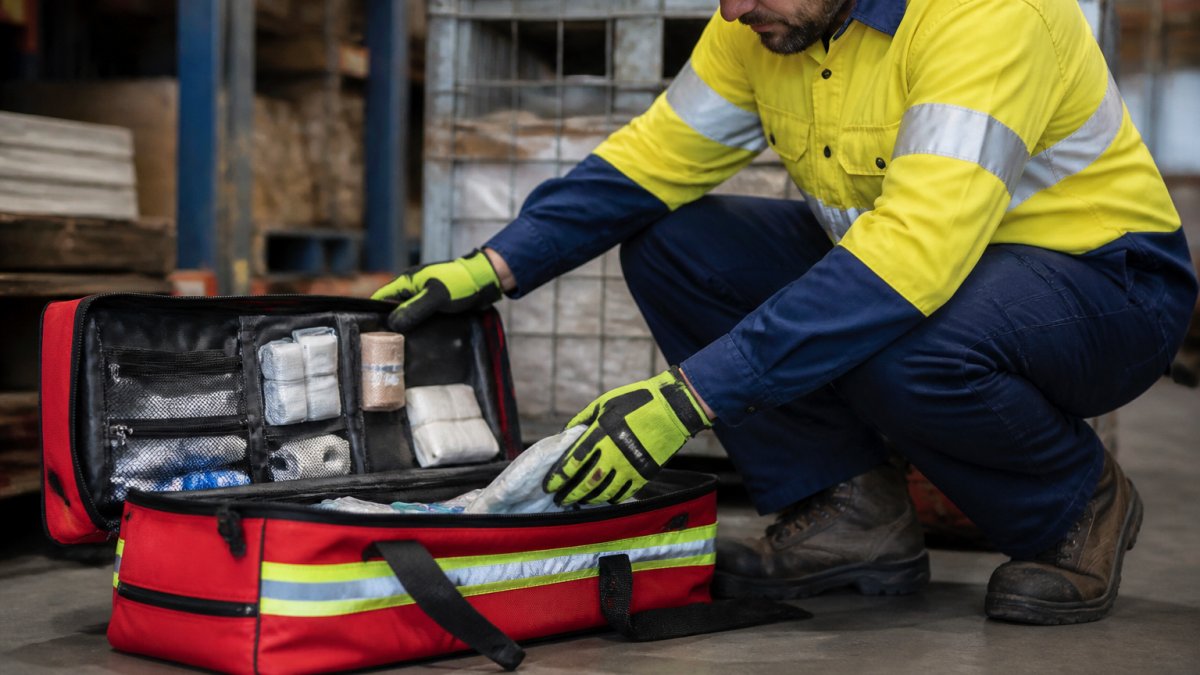
The vibrant red colour with reflective strips ensures instant visibility. The softpack with leather base balances portability and durability. Organised compartments mean responders find items instantly during a crisis.
This kit addresses cuts, burns, fractures, and severe bleeding. For organisations with 50+ staff or high-hazard environments, it's the minimum standard.
RAPIDSTOP Mass Casualty Bleed Response: multi-casualty emergency readiness
The RAPIDSTOP Mass Casualty Bleed Response at $449.99 is engineered for multi-casualty scenarios in mines, heavy industry, and surf clubs.

It contains 4 tourniquets, trauma bandages, packing gauze, face shields, gloves, thermal blankets, shears, and a marker pen, all in an accessible sling pack.
The critical difference: four tourniquets for simultaneous multi-limb stabilisation, and thermal blankets to address shock. This kit suits environments where multi-casualty incidents are statistically possible.
RAPIDSTOP Medium and Small Bleed Control Packs: portable bleeding control
The RAPIDSTOP Medium ($139.99-$219.99) and Small ($89.99-$179.99) Bleed Control Packs balance capability and portability for small to medium workplaces.

Both fit vehicle glove boxes and site bags. Both feature single-handed tourniquets, trauma bandages, shears, and gloves for rapid response.
The Medium pack suits 15-50 staff with moderate hazards. The Small pack works for vehicles and low-hazard environments. Choose based on staff count, hazard level, and paramedic response time.
Workplace first aid kit requirements and compliance
Regulatory requirements
Employers must provide first aid equipment appropriate to workplace hazards and staff numbers. High-risk workplaces (construction, manufacturing, mining) must carry advanced trauma supplies. Low-risk environments (offices, retail) can use standard kits. Match kit contents to likely injuries.
Document your kit choice, why it suits your workplace, and inspection/restock frequency. A kit with no maintenance record is a compliance liability.
Scope of practice: what advanced trauma supplies do
Advanced trauma kits address life-threatening bleeding and shock. Tourniquets, trauma bandages, and packing gauze stop or slow severe haemorrhage. Thermal blankets address shock. Face shields and gloves protect responders.
These supplies buy critical minutes while waiting for paramedics. Correct application preserves limbs and lives; incorrect application causes permanent damage. Training is essential.
What advanced trauma kits cannot do
No workplace kit can replace paramedic care. Kits cannot:
- Manage airway obstruction or breathing difficulty (requires paramedic intubation or bag-valve-mask ventilation)
- Treat internal bleeding (requires hospital imaging and surgery)
- Manage spinal injuries (requires paramedic immobilisation and transport)
- Provide pain relief beyond basic comfort measures
- Diagnose the severity of an injury
- Replace cardiopulmonary resuscitation (CPR) training or defibrillation
A kit is a bridge to emergency care, not a replacement for it.
When to call triple-zero immediately
Do not wait to see if your kit will work. Call triple-zero (000) immediately if:
- Severe bleeding that does not slow with direct pressure within 2-3 minutes
- Suspected amputation or crush injury
- Chest, abdominal, or pelvic trauma
- Difficulty breathing or chest pain
- Loss of consciousness or altered mental state
- Suspected spinal injury (neck or back pain after trauma)
- Severe burns (larger than the person's hand or affecting the face, hands, feet, or genitals)
- Any injury where you are unsure of severity
While waiting for paramedics, your kit and your training are the patient's lifeline. But paramedics are the definitive care.
Training and protocols: the real requirement
A kit without trained responders is a liability. Your workplace should have two staff trained in first aid and trauma response, a documented protocol for emergency response, annual refresher training, and clear kit signage.
Training teaches responders when to escalate to paramedics. An untrained person with a tourniquet risks permanent damage; a trained responder knows when and how to apply it safely.
First aid courses are essential for trauma readiness.
Large Red Softpack Trauma First Aid Kit 49 x 30 x 28.5cm →
Building your trauma kit checklist: selection by workplace hazard level
Selecting the right advanced trauma kits requires a documented risk assessment to justify your kit choice and ensure you're not over-buying or under-prepared.
Step 1: Identify likely injury types at your workplace
Walk through your site and identify likely injuries. Retail shops face slips and minor cuts. Construction sites face crush injuries, lacerations, and amputations. Manufacturing plants face machinery entanglement and burns.
List the top three to five likely injury types. This drives kit contents. No machinery or heights? One tourniquet may suffice. Both present? You need multiple.
Step 2: Count staff and assess geographic spread
Count on-site staff and assess geographic spread. A 20-person office needs one kit in an accessible location. A 20-person site spread across 2 hectares needs multiple kits to minimise response time.
Step 3: Determine paramedic response time
Ring your local ambulance service or check their response-time data for your postcode.
Longer response times justify larger, more comprehensive kits and more frequent staff training.
Step 4: Match kit size and contents to your assessment
Once you've documented likely injuries, staff count, spread, and response time, match your findings to kit options:
Low-hazard, clustered staff, short response time (e.g., office, retail, light admin):
- Small Bleed Control Pack ($89.99-$149.99) in the main office
- Optional: second Small pack in a vehicle
- Staff count: up to 20
- Paramedic response time: typically under 10 minutes
- Rationale: Severe bleeding is rare; minor wounds and shock management are the priority
Medium-hazard, dispersed staff, moderate response time (e.g., light manufacturing, construction trades, community venues):
- Medium Bleed Control Pack ($139.99-$219.99) in the site office
- Second Medium pack in a vehicle or second work zone
- Staff count: 20-50
- Paramedic response time: 10-20 minutes
- Rationale: Trauma injuries are possible; multiple tourniquets and trauma bandages are justified; two kits ensure coverage across the site
High-hazard, large staff, longer response time (e.g., heavy manufacturing, mining, major construction):
- Large Red Softpack ($449.99) or Mass Casualty Bleed Response ($449.99) in the first aid room
- Second comprehensive kit in a site office or vehicle
- Additional Small or Medium packs at remote work zones
- Staff count: 50+
- Paramedic response time: 15-30+ minutes
- Rationale: Severe trauma is statistically likely; multiple kits reduce access time; comprehensive contents address crush injuries, amputations, and multi-casualty scenarios
Step 5: Document your assessment and review annually
Write down your findings: likely injuries, staff numbers, site layout, response time, and the kit(s) you've selected. Attach this document to your first aid kit or store it with your safety records.
Review your assessment annually or whenever your workplace changes (new machinery, site expansion, staff increase, relocation).
Inspection, expiry tracking, and kit maintenance
A trauma kit sitting on a shelf for two years is useless. The supplies inside degrade. Tourniquets lose elasticity. Gauze absorbs moisture. Gloves become brittle. Compliance requires regular inspection and documented maintenance.
Establish a quarterly inspection routine: check expiry dates, verify all items are present, look for physical damage, and confirm the kit is accessible. Many organisations use a simple checklist attached to the kit itself. When you inspect, initial and date the checklist. This creates a paper trail that regulators respect.
Annual restocking is standard practice. Don't wait until items expire, rotate stock proactively. When you deploy a kit in an actual incident, restock immediately. A deployed kit is useless until refilled.
PFA Shop sells individual replacement supplies, so you can restock without buying entirely new kits.
Workplace trauma readiness isn't about having the fanciest kit. It's about matching your kit to your actual hazards, positioning it where responders can find it instantly, and maintaining it so supplies don't expire unused. PFA Shop's range, from Small Bleed Control Packs for vehicles through to comprehensive Large Red Softpack kits and Mass Casualty Response systems, covers every workplace size and hazard level. Start with your workplace risk assessment, select the appropriate kit, and commit to quarterly inspections and annual restocking.
Frequently Asked Questions
What must be in a workplace first aid kit to meet Australian compliance standards?
Australian workplaces must comply with state-based workplace health and safety legislation. Essential items include sterile gauze, adhesive bandages, antiseptic wipes, disposable gloves, triangular bandages, elastic bandages, and eye wash. High-risk workplaces such as construction, manufacturing, and mining require advanced trauma kits with tourniquets, trauma control bandages, and haemostatic dressings. Your risk assessment determines the exact contents needed. The Large Red Softpack Trauma First Aid Kit is designed to meet compliance requirements across construction, manufacturing, and educational settings.
How is an advanced trauma kit different from a standard workplace first aid kit?
Advanced trauma kits focus on life-threatening bleeding and severe injuries, including tourniquets, haemostatic gauze, trauma control bandages, and packing materials. Standard kits address minor cuts, sprains, and burns. Advanced kits suit high-risk workplaces like construction sites, mines, and manufacturing facilities where traumatic injuries are more likely. RAPIDSTOP bleed control kits are purpose-built for rapid haemorrhage control, whereas general first aid kits prioritise common minor injuries. Choose an advanced kit if your workplace involves machinery, heights, or heavy equipment.
What should an advanced workplace trauma kit contain?
Core items include tourniquets for rapid limb occlusion, trauma control bandages for firm compression, haemostatic gauze or dressings to promote clotting, universal shears to expose wounds, nitrile gloves for hygiene, thermal blankets for shock prevention, and marker pens for time documentation. The RAPIDSTOP Medium Bleed Control Pack with QUIKCLOT Combat Gauze ($219.99) includes all these essentials in a portable format. The RAPIDSTOP Mass Casualty Bleed Response ($449.99) provides multiple sets of these items for multi-casualty incidents. Contents vary by kit size and intended use.
How often should workplace trauma kit supplies be checked and replaced?
Inspect kits monthly for physical damage, moisture, or pest intrusion. Check expiry dates on sterile items, dressings, and antiseptic wipes quarterly. Replace expired, opened, or used items immediately. After any incident, restock the kit before returning it to service. Maintain a log of inspection dates and replacements to demonstrate compliance. Document all checks to show due diligence if an incident occurs.