
First Aid Kit Refill Service: Your Complete Guide
Table of Contents
- Why a First Aid Kit Refill Service Beats Piecemeal Restocking
- First Aid Kit Contents List: What Every Refill Should Restore
- First Aid Kit Expiry Dates: When to Replace What
- First Aid Kit Inspection Checklist for Refill Planning
- Choosing the Right Refill for Your Workplace Size and Risk Level
- How a First Aid Kit Restocking Service Keeps You Compliant
- Frequently Asked Questions
Last Updated: October 12, 2026
Why a First Aid Kit Refill Service Beats Piecemeal Restocking
A first aid kit refill service is a scheduled restocking program that replaces used and expired consumables in your existing kits, so you never source individual items yourself. The first aid kit refill service Gold Coast businesses actually need is one built around a cycle, not a one-off purchase.

Piecemeal restocking fails for a simple reason. Nobody owns it. Someone grabs a bandage, nobody logs it, and three months later the kit is missing half its contents during an audit. A refill service puts a fixed rhythm around the whole job.
The difference shows up in two places: inspection results and incident response. When your kit is checked on a schedule and topped up in one step, you always know what is inside it.
First Aid Kit Contents List: What Every Refill Should Restore
A complete first aid kit contents list covers wound care, bandaging, cleansing, and protection items, and a proper refill restores all four categories at once. Anything less leaves gaps you will only discover mid-incident.

Here is what a full workplace refill should bring your kit back to:
- Adhesive plasters in assorted sizes for small cuts and grazes
- Gauze swabs and wound pads for coverage across different wound sizes
- Combine dressings and non-adherent pads for larger wounds
- Conforming and elastic bandages for support and compression
- Triangular bandages for immobilisation and slings
- Fixation tape to secure dressings in place
- Saline ampoules and cleansing wipes for wound cleaning
- Disposable gloves, shears, and forceps for safe application
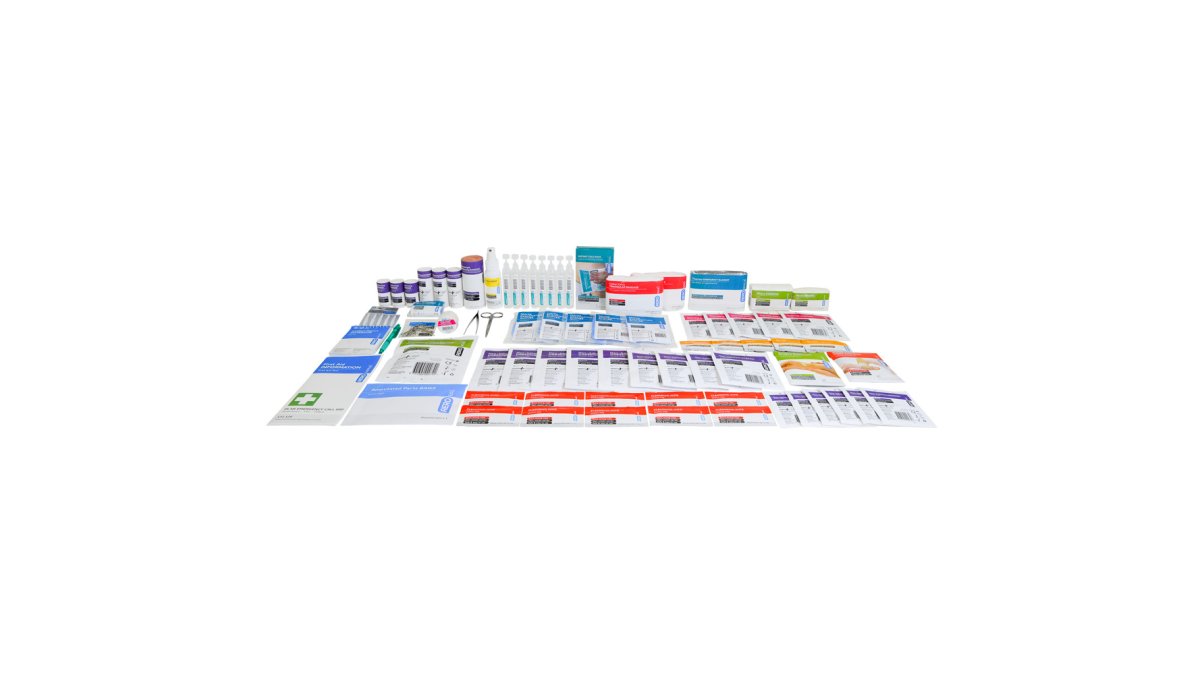
The mistake we see most often is buying refills by item count rather than by category. A kit with forty plasters and no combine dressing looks well stocked until someone needs serious wound coverage.
For medium and large sites, the COMMANDER 6 Series First Aid Kit Refill restores the full spread of dressings, bandages, tapes, wipes, gloves, and emergency accessories in one step, which suits construction sites, warehouses, and high-risk facilities. Smaller operations tend to do better with the RESPONDER 4 Series First Aid Kit Refill, built for workplaces of roughly 1 to 25 people in low to medium risk settings.
First Aid Kit Expiry Dates: When to Replace What
First aid kit expiry dates vary by item type, and treating them as one date is the fastest way to fail an audit. Sterile items, liquids, and adhesives all age differently.

As a working rule:
Item type |
Typical replacement trigger |
Why it matters |
|---|---|---|
Sterile dressings and pads |
Sealed pack damaged or past marked date |
Sterility cannot be assumed once compromised |
Saline ampoules and eyewash |
Past marked date |
Solution quality is not guaranteed |
Adhesive plasters and tapes |
Adhesive fails or past marked date |
Dressings will not stay in place |
Cleansing wipes |
Pack dried out or past marked date |
Reduced cleaning effectiveness |
Gloves |
Degraded, brittle, or past marked date |
Barrier protection is compromised |
Check every item against its own printed date rather than the kit's purchase date. A kit bought eighteen months ago can easily contain items with different remaining life.
First Aid Kit Inspection Checklist for Refill Planning
A first aid kit inspection checklist turns refill planning from guesswork into a ten-minute job. Run it monthly, and again after any incident where items were used.
- Confirm the kit is accessible and clearly signed
- Check the case or cabinet for damage, rust, or broken latches
- Count each item against the kit's contents list
- Check every printed expiry date
- Inspect sterile packaging for tears, moisture, or contamination
- Test that tapes and plasters still adhere
- Confirm gloves are intact and correctly sized
- Note every missing or expired item on a restock sheet
- Record the inspection date and who completed it
That last step matters more than most people expect. A dated record is what turns your kit maintenance into evidence you can produce when someone asks.
According to Safe Work Australia's model Code of Practice for First Aid in the Workplace, first aid equipment must be maintained and inspected regularly, with records kept of those checks. The specific interval depends on your risk profile and how many people your kit covers.
The most common error here is counting items without checking dates. A kit can be at full count and still be non-compliant because half the saline expired last year.
COMMANDER 6 Series First Aid Kit Refill →
Choosing the Right Refill for Your Workplace Size and Risk Level
Match the refill to your headcount and risk level, not to the size of the cabinet. A large case with the wrong contents is no better than a small one.
Use this as a starting point:
Workplace profile |
Refill to consider |
Price |
|---|---|---|
Compact kits, vehicles, small offices, light risk |
$27.99 |
|
Routine restocking, workshops, mobile teams |
$43.50 |
|
Around 1-25 people, low to medium risk |
$89.99 |
|
Warehouses, factories, construction, higher risk |
$129.99 |
|
Medium to large sites needing broad cover |
$229.99 |
Two categories sit outside the general workplace range and are worth knowing about. Food and beverage environments need kits that account for knife cuts, hot surfaces, and cross-contamination, which is what the RESPONDER 4 Series Food & Beverage Kit Refill at $124.99 and the COMMANDER 6 Series Food & Beverage Kit Refill at $259.99 are built for. Sports clubs and event organisers should look at the REGULATOR 3 Series Sports First Aid Refill at $73.40.
Buying the largest kit available wastes money on stock that expires before you use it.
How a First Aid Kit Restocking Service Keeps You Compliant
A first aid kit restocking service keeps you compliant by making maintenance scheduled, documented, and consistent across every location. Compliance is not a one-time purchase. It is a record of ongoing care.
Work health and safety duties require that first aid arrangements be maintained and reviewed, not just installed. The Work Health and Safety Regulation 2011 sets out duties that apply to how first aid is provided and kept current in the workplace. For most businesses, the practical obligation is straightforward: know what you have, keep it in date, and be able to show you checked.
Where a service earns its keep is standardisation. When every kit on every site carries the same contents in the same layout, staff recognise items faster, audits take less time, and training gets easier to deliver.
A restocking cycle removes all three.
Keeping first aid kits current is one of those jobs that quietly slips until an inspection or an incident exposes the gap. PFA Shop supplies refills built for the way workplaces actually operate, including specialised marine and rail kits, professional-grade resuscitation equipment, and a full range of AEDs and accessories. Get started with PFA Shop and keep every kit on site ready, dated, and compliant.
Frequently Asked Questions
What should be included in a workplace first aid kit?
A workplace kit needs dressings in multiple sizes, bandages, fixation tape, cleansing wipes or saline ampoules, disposable gloves, and basic instruments such as shears. The exact mix depends on your risk level. A low-risk office might suit a compact kit, while a construction site needs broader coverage for serious bleeding and trauma. Check your kit against a first aid kit contents list before ordering a refill so you know exactly what is missing.
How often should a workplace first aid kit be checked?
Check your kit monthly for missing or used items, and do a full audit quarterly that includes expiry dates. High-traffic sites with frequent incidents may need fortnightly checks. Use a first aid kit inspection checklist so nothing gets missed, and record each check with a date and initials. Regular checks mean you can order a refill before an incident happens, not after.
Can you refill a first aid kit instead of replacing it?
Yes, and it usually costs far less. If the case or cabinet is still in good condition, a dedicated refill restores all consumables in one purchase. Options range from the VOYAGER 2 Series First Aid Kit Refill at $27.99 for compact kits through to the COMMANDER 6 Series Food & Beverage Kit Refill at $259.99 for high-capacity food environments. You avoid buying a new container and reduce waste.
How do I know which first aid kit refill supplies I need?
Start with your kit series and size. The RESPONDER 4 Series suits 1-25 people in low to medium risk settings, while the OPERATOR 5 Series covers higher risk industrial environments. Then check what is actually depleted or expired inside your case. If you run a food business, a dedicated food and beverage refill includes hygiene-focused items. Matching the refill to your kit series ensures every component fits and the layout stays consistent.