
9 First Aid Supplies Every Kit Needs
Last Updated: November 4, 2026
Quick Summary
The first aid supplies every kit needs are nine core categories: adhesive plasters, sterile wound dressings, conforming and cohesive bandages, sterile saline, eye pads, disposable gloves, a resuscitation face shield, a disposable cold pack and a shock blanket. Everything else is a specialisation, such as burns kits, bleed control packs and eyewash stations, which earn their place when the setting creates that specific hazard.
- Match first aid supplies to the hazards where the kit lives, not to a generic checklist.
- Work backwards from what injuries are plausible, how many people are on site and how far help is.
- Store vehicle kits in the cabin, because heat degrades adhesive and gel packs.
- Check kits monthly for missing items and expiry dates quarterly, recording the earliest date.
- Irrigate wounds and eyes with sterile saline before covering them with a dressing.
Table of Contents
- What First Aid Supplies Actually Belong in a Kit
- First Aid Kit Contents by Setting: Home, Vehicle and Travel
- Workplace First Aid Kits and Australian Compliance
- Choosing a Marine First Aid Kit for Saltwater Conditions
- Trauma, Burns and Bleed Control Supplies Worth Adding
- First Aid Kit Refills: Expiry Dates, Inspection and Restocking
- How to Use Common Supplies Safely
- Build Your Kit With PFA Shop
- Frequently Asked Questions
What First Aid Supplies Actually Belong in a Kit
Most kits fail at the moment they matter, and not because the owner was careless. They fail because the box was assembled around a checklist rather than a risk. A common pattern is a glovebox kit with plasters but nothing to control serious bleeding, or a workshop kit with three sizes of bandage and no eyewash. The right first aid supplies are the ones matched to what can actually go wrong where the kit lives.
A first aid kit is a defined set of dressings, bandages, irrigation items and protective equipment, packed together so a bystander can treat an injury without searching. That definition matters, because it sets the test for every item you add: could an untrained person find it and use it under stress?
The Core Items Every Kit Should Carry
Nine categories cover the overwhelming majority of injuries a workplace, home or vehicle will see:
- Adhesive plasters in several sizes for minor cuts and grazes
- Sterile wound dressings and non-adherent pads for larger breaks in the skin
- Conforming and cohesive bandages to secure dressings and support joints
- Sterile saline for flushing wounds and eyes
- Eye pads for covering an injured eye after irrigation
- Disposable gloves for hygiene and barrier protection
- A resuscitation face shield for rescue breathing
- A disposable cold pack for sprains, bumps and swelling
- A shock blanket to keep an injured person warm while help is on the way
Everything else is a specialisation. Burns kits, bleed control packs and eyewash stations earn their place when the setting creates that specific hazard.
Matching Supplies to Risk and Group Size
A common mistake is buying one kit size for every situation. Two people in a home office and fifteen people on a construction site do not face the same injuries, and a kit that suits one will be wrong for the other.
Work backwards from three questions. What injuries are plausible here? How many people are on site at once? How far is the nearest ambulance or clinic? A remote site with slow access needs more haemorrhage control and more burns cover than an inner-city office. A food handling area needs high-visibility blue dressings so a lost item is easy to spot.
Safe Work Australia's first aid in the workplace guidance sets out the risk-based approach regulators expect: assess hazards, then size your kit and your trained personnel accordingly.
First Aid Kit Contents by Setting: Home, Vehicle and Travel
The core list stays the same. What changes is the container, the extras and how quickly you can reach it.
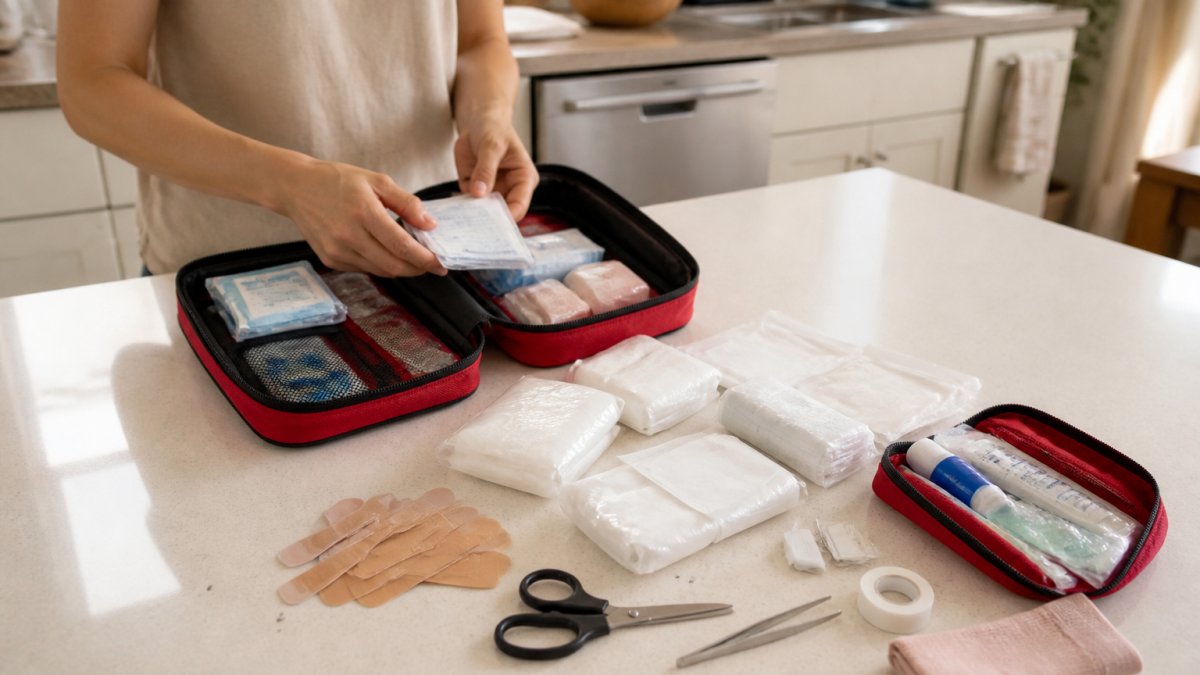
Home: a soft pack stored somewhere dry and known to everyone in the household. Add a burns kit for the kitchen and a dedicated eyewash kit if anyone works on cars or in the garden.
Vehicle: heat is the enemy. A kit left in a car through summer will cook adhesive and degrade gel packs, so choose a soft case and store it in the cabin rather than the boot where possible.
Travel and outdoor: compact, light and sealed against moisture. A personal kit with plasters, a cohesive bandage, saline and a cold pack handles most walking and camping injuries.
Setting |
Container |
Add beyond the core nine |
Key constraint |
|---|---|---|---|
Home |
Soft pack |
Burns kit, eyewash |
Dry storage, known location |
Vehicle |
Soft case |
Cold pack, extra dressings |
Heat degradation |
Travel and outdoor |
Compact sealed pouch |
Snake bite bandage, blister care |
Weight and moisture |
Workplace |
Soft pack or cabinet |
Bleed control, eyewash station |
Compliance and signage |
Marine |
Water-resistant case |
Seasickness and sun items |
Salt and spray |
Workplace First Aid Kits and Australian Compliance
Compliance is not a product you buy. It is a set of arrangements, and the kit is one part of it. Under the model Work Health and Safety Regulations, a person conducting a business or undertaking must provide first aid equipment and access to facilities, and the specifics are set by the regulator in each state and territory. Safe Work Australia's model Code of Practice for First Aid in the Workplace describes how to assess your needs and what a kit should contain.
What the Regulations Require of Your Kit
Workplace first aid is generally expected to be adequate for the hazards and workforce size at your site, accessible to workers, maintained, and supported by trained first aiders and clear signage.
Our advice for a small construction crew is blunt: buy a kit built for the hazard, not the headcount alone. Workplace readers can also review the bleed control kit rules every workplace should know.
For a fixed workplace, the AEROKIT First Aid Station with 6 Modules ($425.00) holds up to twelve interchangeable modules and has space for eyewash bottles, defibrillators and bleed control kits.
Safe Work Australia's WHS duties and obligations is worth reading before you finalise any first aid purchase, because the duty sits with the business, not the supplier.
Choosing a Marine First Aid Kit for Saltwater Conditions
Salt water destroys ordinary kits. Steel corrodes, cardboard cartons collapse, and paper instructions turn to pulp within a season. A marine first aid kit needs water-resistant packaging, sealed contents and supplies chosen for the injuries that actually happen on the water.
Those injuries are predictable: lacerations from hooks and props, sunburn, seasickness, sprains from an unstable deck, and eye irritation from spray or fuel. Add remote access, and the case for a proper kit rather than a repurposed glovebox one becomes obvious. For a deeper guide, read our best marine first aid kit features.
Store the kit high and dry, not in a wet locker. Check it before every trip rather than once a season, and replace anything that has been damp.
Trauma, Burns and Bleed Control Supplies Worth Adding
Serious bleeding is the injury where the gap between a basic kit and a prepared one is measured in minutes. Direct pressure handles most wounds.
Modulator 4 Series - First aid kit soft pack →
The RAPIDSTOP Medium Bleed Control Pack with QUIKCLOT Combat Gauze ($219.99) is built around exactly that workflow.
Burns deserve their own kit rather than a hopeful improvisation. For a comparison of the best bleed control kits available in Australia, see our best bleeding control kits for trauma in Australia.
Eye injuries are the third gap. The REGULATOR Eyewash First Aid Kit ($26.80) packs sterile single-use irrigation and eye coverings into a 21 × 7.5 × 13 cm case that fits a wall cabinet or a vehicle.
First Aid Kit Refills: Expiry Dates, Inspection and Restocking
Expiry tracking is where most kits quietly fail. If you want a practical method for tracking first aid expiry dates, our guide walks through it step by step.
A workable routine looks like this:
- Label every kit with the date it was last checked
- Check monthly for missing or opened items
- Check expiry dates quarterly and record the earliest date on the kit label
- Replace anything used immediately, not at the next audit
- Keep a small stock of spares for the items you use most
The Modulator 4 Series First Aid Kit Soft Pack ($145.00) makes this easier than most, because its six colour-coded injury-specific modules let you see at a glance which module needs restocking. It meets and exceeds standard workplace regulations across every state and territory.
When it is time to restock, buy refills rather than a whole new kit. You can browse the first aid refill kits collection and buy what you need.
Watch out: replacing a sterile dressing with a non-sterile one defeats the purpose of the kit. Match the refill to the original item.
How to Use Common Supplies Safely
Knowing what is in the kit is half the job. Using it correctly is the other half, and a few habits prevent most harm.
Gloves first. Nitrile gloves protect both people. The AEROKIT 3 Series and the RapidStop pack are both latex-free, which matters for rescuers and casualties with latex sensitivity.
Irrigate before covering. Flush wounds and eyes with sterile saline, then dress.
Cool a burn, do not ice it. Use the gel dressings in the AEROBURN kit and cover with the conforming bandage. Do not apply ice directly to skin.
Record tourniquet time. The marker in the RapidStop pack exists for a reason.
Watch out: a tourniquet applied to a bleed that direct pressure would have controlled causes unnecessary harm. Use it when pressure fails, not as a first move.
Build Your Kit With PFA Shop
The test of any first aid supplies purchase is simple: could someone find the right item and use it correctly in the first two minutes? Build around the nine core categories, then add the specialisations your setting demands, whether that is a bleed control pack for a workshop, a burns kit for a kitchen or an eyewash station for a dusty site.
Kits are available for small crews and single households through to full workplace stations, and individual refills can be bought to maintain a kit rather than replace it.
Get started with PFA Shop and build a kit that is ready the moment someone needs it.
Frequently Asked Questions
What should be included in a basic first aid kit?
A basic kit needs sterile dressings, adhesive bandages, a conforming bandage, eye pads, sterile saline, disposable gloves, a resuscitation face shield, scissors, and a shock blanket. Add a burns kit and a cold pack for household use. The AEROKIT 3 Series at $49.99 covers cuts, grazes, eye injuries, burns and snake bites in one soft case, which makes it a sensible starting point for a home or vehicle kit.
What first aid supplies should a workplace have?
Workplace first aid kits should reflect your hazards, staff numbers and shift patterns. At minimum, expect dressings, bandages, eye pads, saline, gloves, a resuscitation face shield, and burn care. Higher-risk sites such as construction and manufacturing should add bleed control supplies and eyewash. The Modulator 4 Series at $145.00 uses six colour-coded modules that meet and exceed workplace regulations for every state and territory.
How often should first aid supplies be checked and replaced?
Check your kit monthly and do a full audit quarterly. Look for expired sterile items, damaged packaging, missing consumables and depleted stock. Sterile dressings and saline carry expiry dates and must be replaced once passed. Keep a simple log of what was used and when, so first aid kit refills are ordered before an item runs out rather than after an incident.
What supplies are needed for a marine first aid kit?
A marine first aid kit needs waterproof storage, extra sterile dressings, cohesive bandages that hold under movement, seasickness and sunburn items, and bleed control supplies for hook and propeller injuries. Saltwater exposure ruins cardboard packaging, so sealed pouches matter. The AEROBAN Blue Cohesive Bandage at $64.99 per wrap of 12 is latex free, hand-tearable and holds position without clips, which suits wet, moving decks.
What is the difference between a first aid kit and first aid supplies?
A first aid kit is the complete packaged unit, case included, ready to grab in an emergency. First aid supplies are the individual consumables inside it: dressings, bandages, saline, gloves and refills. Most buyers start with a kit and then top up supplies as items expire or get used. Buying refills separately is cheaper than replacing a whole kit each time one dressing runs out.
A kit is only as good as its last inspection. If your current supplies are past their date or missing half their contents, we can help you rebuild it properly. Browse the range at PFA Shop, check the refills against your hazard assessment, and put a monthly check in the calendar before the next incident finds the gap.
