
Is a Portable Defibrillator Worth It for Small Business?
Last Updated: October 29, 2026
Quick Summary
A portable defibrillator for a small business starts at $1,495 and can climb past $3,200 once you add a cabinet, signage and a prep kit. It is worth it because a sudden cardiac arrest on your site gives you roughly ten minutes before the odds collapse, and an AED is the only tool a bystander can use in that window.
- The Elliot Pocket AED is the lowest-priced model at $1,495 and the lightest at 680 grams.
- The Mindray C2 adds a colour display for workplaces with mixed confidence levels.
- The Defibtech Lifeline offers a 7-year battery standby life for remote sites with infrequent checks.
- Check the status indicator weekly and replace pads before their expiry date, typically every two to five years.
- A unit with a green status light can still have expired pads, so the light alone does not prove readiness.
Table of Contents
- What a Portable Defibrillator Actually Costs a Small Business
- Elliot Pocket AED: The Budget Pick for Tight Safety Budgets
- Mindray C1A and C2: Screen-Guided AEDs for Mixed-Ability Teams
- LIFEPAK CR2 and Defibtech Lifeline: When the Site Is the Problem
- AED Maintenance Requirements in Australia: What Keeps a Unit Ready
- The Real Cost of an AED for Small Business in AUD
- Automated External Defibrillator Training Requirements for Your Team
- Choosing the Right Defibrillator for Your Workplace
- Frequently Asked Questions
What a Portable Defibrillator Actually Costs a Small Business
A portable defibrillator for small business use starts at $1,495 and climbs past $3,200 once you add a cabinet, signage and a prep kit. The question small business owners often ask is not which model has the best specs. It is whether the spend is justified at all for a team of fifteen.
Here is the short answer: a sudden cardiac arrest on your site gives you roughly ten minutes before the odds collapse. An AED is the only tool a bystander can use in that window. Everything below is about picking the right one without overpaying.
The comparison table: seven AEDs side by side
Model |
Price (AUD) |
Weight |
Mode |
Best for |
|---|---|---|---|---|
Elliot Pocket AED |
$1,495 |
680 g |
Fully automatic |
Tight budgets, mobile teams |
Elliot Grab and Go Package |
$1,720 |
680 g |
Fully automatic |
Sites that need a case and prep kit |
Mindray C1A |
$1,900 |
2.0 kg |
Fully automatic |
General workplace use |
Defibtech Lifeline |
$2,300 |
2 kg |
Semi or fully auto |
Long battery life, remote sites |
Mindray C2 |
$2,450 |
2.3 kg |
Fully automatic |
Mixed-ability teams, screen guidance |
LIFEPAK CR2 Essential Semi |
$2,999.99 |
Compact |
Semi-automatic |
Noisy, high-traffic sites |
LIFEPAK CR2 Essential Fully |
$3,265 |
Compact |
Fully automatic |
Public access, multi-site programs |
The costs beyond the sticker price
Budget for a cabinet or case, an AED prep kit, replacement pads every few years, and batteries alongside the unit. The Australian Resuscitation Council guidelines set out why pad and battery expiry matters more than most buyers expect: a unit with expired consumables will not deliver therapy.
Elliot Pocket AED: The Budget Pick for Tight Safety Budgets
If your safety budget is the constraint, the Elliot Pocket AED is a budget-friendly option to consider. At $1,495 it is the lowest-priced model here, and at 680 grams it is the lightest unit listed.
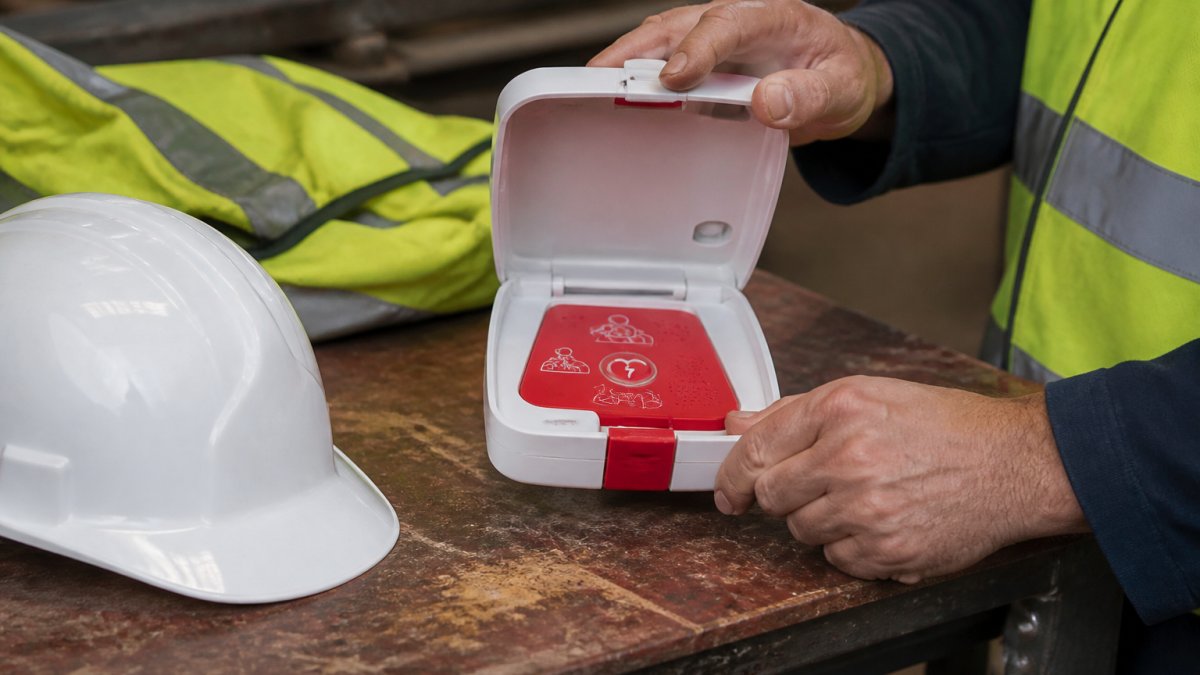
What it does well: adult and paediatric mode run on the same pads with one-button switching, so nobody has to hunt for a second set. It is IP66 rated, ARTG listed, and runs on four standard CR123A batteries costing about $20 to $40 to replace. Daily self-checks report through the HeartHero app.
Where it falls short: there is no screen. Rescuers get voice prompts and a CPR metronome, not visual guidance. For a confident team that is fine. For a mixed-ability crew, read the next section.
Best for: small teams, vehicles, and sites that need a second unit. Skip if: you want on-screen coaching for untrained rescuers.
You can view the Elliot Pocket AED and its full specifications.

Mindray C1A and C2: Screen-Guided AEDs for Mixed-Ability Teams
The Mindray C2 is a model suited to workplaces with a wide spread of confidence levels. Its colour display shows step-by-step visuals alongside voice prompts, which matters when the person responding has never touched a defibrillator.
The C1A is the lighter sibling at 2.0 kg and $1,900, with the same ResQNavi coaching and QShock analysis that gets a shock ready in under eight seconds. The C2 adds the screen and 2.3 kg of build for $2,450. Both carry IP55 protection and an 8-year warranty as listed.
The honest limitation: these are heavier and bulkier than the Elliot. If your unit lives in a vehicle or gets carried between sites, that weight tells after a while.
Best for: factories, warehouses and offices with rotating staff. Skip if: portability is the deciding factor.
You can check the Mindray C2 defibrillator in detail.
LIFEPAK CR2 and Defibtech Lifeline: When the Site Is the Problem
Two models earn their price on difficult sites. The LIFEPAK CR2 is built for noise: ClearVoice technology lifts prompt volume on factory floors and transport hubs, and the semi-automatic version at $2,999.99 keeps shock delivery in the responder's hands with a flashing button.
The Defibtech Lifeline sits at $2,300 with a 7-year battery standby life. The battery window is a notable feature for remote sites where frequent maintenance is hard to manage.
Best for: noisy industrial sites and locations with infrequent checks. Skip if: your workplace is quiet and someone walks past the unit weekly.
Elliot - POCKET AED Australia’s smallest, smartest & most affordable →
You can review the LIFEPAK CR2 specifications for demanding environments.
AED Maintenance Requirements in Australia: What Keeps a Unit Ready
AED maintenance requirements in Australia come down to four checks: the status indicator, the pads, the battery, and a documented record. Most units self-test daily, but a self-test only reports a fault. Someone has to look.
- Check the status indicator weekly and log it
- Replace pads before their expiry date, typically every two to five years
- Replace the battery on schedule, not when it fails
- Run a monthly functional test where the unit supports it
- Keep a written register of checks for your WHS records
The Safe Work Australia guidance on first aid treats first aid equipment as part of your duty to provide a safe workplace, and that includes keeping it in working order.
Watch out: a unit with a green status light can still have expired pads. The light says the electronics work. It says nothing about the consumables.
The Real Cost of an AED for Small Business in AUD
The cost of an AED for small business in AUD runs from about $1,495 for a bare unit upward once you add a cabinet, prep kit and signage. Our portable defibrillator price guide breaks the full range down model by model.
A realistic small-business setup looks like this:
Item |
Typical cost (AUD) |
|---|---|
AED unit |
$1,495 to $3,265 |
Alarmed cabinet |
$339.99 to $375.90 |
Prep kit and case |
Bundled on some packages |
Pads, every few years |
Varies by model |
Battery, every few years |
About $20 to $40 on the Elliot |
The Heart Foundation's resources on cardiac arrest make the case for access clearly enough that the budget conversation usually ends quickly.
Automated External Defibrillator Training Requirements for Your Team
Modern units are designed for untrained rescuers, and many models provide voice prompts to guide the user.
That said, we recommend a short familiarisation session for every team. A short familiarisation session with the unit open and the prompts playing can help reduce hesitation in an emergency. The Australian Resuscitation Council publishes current guidance on CPR and defibrillation sequence worth reading before you brief staff.
If you want reassurance on how simple these units are for laypeople, our guide on whether AEDs are easy for laypeople to use covers it plainly.
Choosing the Right Defibrillator for Your Workplace
Choosing comes down to three questions. How many people are on site? How confident are they? And how hard is the unit's location to reach?
- Under 15 staff, tight budget: Elliot Pocket AED at $1,495
- Mixed confidence levels: Mindray C2 with its screen guidance
- Noisy or high-traffic site: LIFEPAK CR2
- Remote site, infrequent checks: Defibtech Lifeline with its 7-year battery
Consider more than price when choosing. Think about who will be on site when the unit is needed.
Frequently Asked Questions
Is it a legal requirement for small businesses to have a defibrillator?
There is no blanket national law forcing every small business to install a portable defibrillator. Duties sit under work health and safety legislation. Check the rules that apply to your site and your risk assessment rather than assuming a single standard covers you.
How much does a portable defibrillator cost for a small business?
In this range, prices run from $1,495 for the Elliot Pocket AED up to $3,265 for the LIFEPAK CR2 Essential Fully-Automatic. The Elliot AED Package with a hardshell case and prep kit is $1,720, the Mindray C1A is $1,900, both Defibtech Lifeline models are $2,300, the Mindray C2 is $2,450 and the LIFEPAK CR2 Essential Semi-Automatic is $2,999.99. Budget separately for pads, batteries and a cabinet, which are not always included.
What is the difference between a semi-automatic and fully automatic AED?
A semi-automatic unit analyses the rhythm and charges, then waits for the rescuer to press a flashing shock button. A fully automatic unit delivers the shock itself after warning everyone to stand clear. Fully automatic models remove the hesitation risk for untrained staff; semi-automatic models keep the final decision with the responder. Both Defibtech Lifeline versions cost $2,300, so the choice is about your team, not your budget.
How often does a portable defibrillator need to be serviced?
Most units run automatic self-tests and show a status indicator, so your job is checking that indicator and logging it. Pads and batteries have expiry dates, so replace consumables before expiry and keep a written record for your safety file.
Do staff need special training to use a portable defibrillator?
No qualification is required to operate an AED, and units like the Elliot are built for untrained rescuers with voice prompts, visual guidance and a CPR metronome. That said, sending a few staff through CPR and defibrillation training shortens response time and builds confidence. Combine training with a fixed storage location and clear signage so anyone can find the unit under stress.
A cardiac arrest on your site will not wait for a budget review. PFA Shop stocks ARTG-listed defibrillators, alarmed cabinets and prep kits so your team has the right equipment in reach, backed by guidance on maintenance and setup. Get started with PFA Shop and put a working unit within reach of everyone on site.
