
Are AEDs Easy for Laypeople to Use? A Clear Guide
Table of Contents
- Are AEDs Easy for Laypeople to Use?
- How to Use an AED: The Full Emergency Sequence
- AED Pad Placement: Getting the Electrodes Right
- AED Voice Prompts: What the Device Tells You to Do
- Common AED Mistakes and How to Avoid Them
- Adult, Child and Infant Pads: Who Gets Which
- Does Training Change How Easy an AED Feels?
- Choosing an AED That Suits Untrained Rescuers
- Frequently Asked Questions
Last Updated: October 18, 2026
Are AEDs Easy for Laypeople to Use?
Yes, AEDs are designed to be easy for laypeople to use. An automated external defibrillator is a portable device that checks a person's heart rhythm and delivers a controlled shock when a shockable rhythm is detected.
Here is the honest version. The device talks you through it. You cannot easily shock someone who does not need it. But "easy" still depends on the person, the moment and the machine.
Why the Answer Is a Qualified Yes
Modern AEDs are built around the untrained rescuer. They switch on with one button or by opening a lid, speak instructions out loud, and analyse the heart rhythm themselves to decide whether a shock is needed.
That removes the hardest decision from your hands. You are not diagnosing anything. You are following prompts.
The qualifications matter too. Panic slows people down. Pad placement still needs care. And a device that has not been maintained may not be ready when you need it.
How to Use an AED: The Full Emergency Sequence
The sequence is short and follows the same pattern on almost every model: call for help, start CPR, send someone for the AED, then let the device guide you.
- Check the scene and the person. Make sure the area is safe. Tap the person and shout. If they do not respond and are not breathing normally, treat it as cardiac arrest.
- Call emergency services. Dial Triple Zero (000) and put the phone on speaker. The operator can coach you through CPR.
- Start chest compressions. Push hard and fast in the centre of the chest. Do not wait for the AED to arrive before starting.
- Send someone for the AED. In a workplace or public venue, the device should be signed and within reach.
- Turn the AED on. Press the power button or lift the lid, depending on the model. It will start talking immediately.
- Attach the electrode pads. Bare the chest, dry it if wet, and place the pads as shown on their pictures.
- Let the device analyse. Everyone stands clear and stops touching the person while the rhythm is checked.
- Deliver the shock if advised. On a fully automatic unit, it shocks on its own. On a semi-automatic unit, you press the flashing button when told.
- Resume CPR immediately. Keep compressions going until paramedics arrive or the person starts breathing.
The Australian Resuscitation Council publishes guidance on defibrillation that underpins this sequence, and it is worth reading before you ever need it: Australian Resuscitation Council guideline on defibrillation.
AED Pad Placement: Getting the Electrodes Right
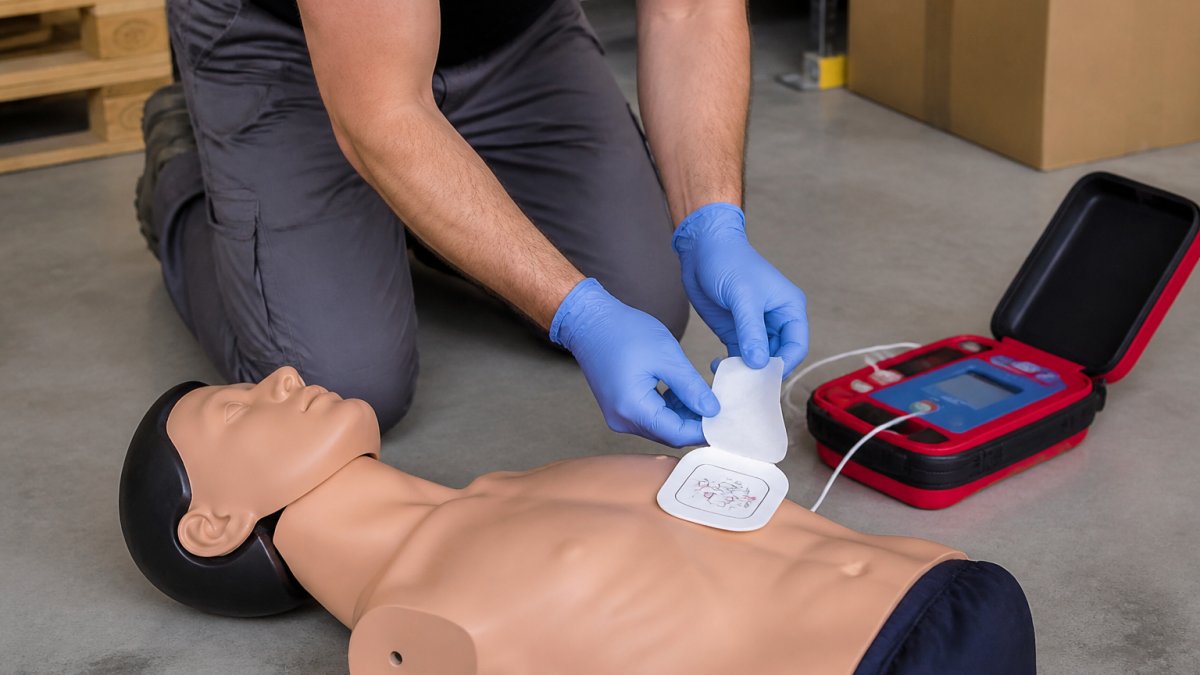
Pad placement is where untrained rescuers most often hesitate, and it is simpler than it looks. Peel each pad from its backing and press it firmly onto bare, dry skin.
The pads themselves carry pictures showing exactly where they go. Follow the picture on the pad, not your memory.
A few practical points:
- Bare the chest properly. Clothing blocks contact. Cut clothing off if you have to.
- Dry the skin. Sweat or water weakens the pad's grip. Wipe and press again.
- Remove medication patches. A patch on the chest can interfere with the shock.
AED Voice Prompts: What the Device Tells You to Do
Voice prompts are the reason an untrained rescuer can operate an AED at all. The device narrates each step in plain language, and the sequence is consistent across brands. Knowing what is coming removes the fear of the unknown.
A typical prompt sequence runs like this:
- "Call for help" or a siren tone on power-up.
- "Remove clothing from the patient's chest."
- "Attach electrode pads", often with a diagram on the pad packaging or screen.
- "Do not touch the patient. Analysing rhythm."
- "Shock advised" or "No shock advised."
- "Stand clear. Press the flashing shock button" (semi-automatic) or "Shock delivered" (fully automatic).
- "It is safe to touch the patient. Begin CPR", often followed by a metronome or compression rate prompt.
Most units pair audio with visual cues: a light flashes on the shock button, a screen shows pad positions, and some models add a full-colour display with step-by-step visuals.
When You Cannot Hear or Understand the Prompts
Background noise is a real problem in workshops, on factory floors and at sporting events. Better models adjust volume automatically, and some use noise-cancelling technology. If you cannot hear clearly, move closer to the unit or have a second person relay the instructions.
Language and sensory limitations matter too. Most Australian-market devices default to English but can be set to other languages at commissioning.
If a prompt contradicts what you expected, for example, "no shock advised" when you feared the worst, follow the device. It is analysing the rhythm, not the situation, and it will tell you to resume CPR if a shock is not appropriate.
Common AED Mistakes and How to Avoid Them
Most AED mistakes come from rushing, not ignorance. The device is forgiving, but a few errors recur often enough to name.
- Delaying compressions while someone fetches the AED. Start CPR first. The AED supplements compressions, it does not replace them.
- Touching the person during analysis. Contact can distort the rhythm reading. Say "stand clear" out loud and mean it.
- Pausing too long after a shock. Resume compressions the moment the device says so.
Adult, Child and Infant Pads: Who Gets Which
Pad choice depends on the person's size, and getting it right matters for the energy delivered. Adults and children over roughly eight years get adult pads.
Defibtech Defibrillator AED Fully-Auto With 7yr Battery →
Some modern units remove the decision entirely. The LIFEPAK CR2 uses a single electrode set for both adults and children, with child mode lowering the energy without a pad change.

If you only have adult pads and the patient is a small child, use them. A lower-energy shock is better than no shock.
Patient |
Pads or setting |
Notes |
|---|---|---|
Adult |
Adult pads |
Standard placement, front and side |
Child over 8 |
Adult pads |
Same as adult |
Child under 8 |
Paediatric pads or child mode |
Lower energy dose |
Infant |
Paediatric pads if available |
Front and back placement if pads risk touching |
Does Training Change How Easy an AED Feels?
Training changes confidence far more than raw capability, a distinction that matters, because the research on untrained rescuers is more nuanced than either the marketing or the sceptical headlines suggest.
What Untrained Rescuers Actually Get Right and Wrong
Most studies of untrained laypeople find the basic sequence, power on, attach pads, follow prompts, is completed successfully by the majority.
Simulation research commonly finds untrained participants take longer to apply pads and are more likely to place them outside the ideal position, particularly on a sweaty or hairy chest. The device will usually still analyse correctly, but the delay and poorer contact reduce shock effectiveness.
What Training Actually Changes
A short CPR and defibrillation course does four concrete things:
- It removes the freeze. People who have held the pads and heard the prompts once are far more willing to start.
- It builds pad-placement accuracy. Repeated practice on a manikin corrects the common errors, too high, too low, overlapping, on clothing. The Australian Resuscitation Council recommends regular practical training.
- It trains the pause discipline. Rescuers learn to stand clear during analysis and to resume compressions the moment the device says so, rather than waiting for reassurance.
The Training Gap Competitors Do Not Address
Most guides stop at "training is good." The more useful question is what minimum training actually shifts performance. A short session covering recognition, compressions and one full AED cycle is enough to move a nervous bystander from hesitation to action.
We recommend a basic CPR and defibrillation course for anyone expected to respond at work. It is not a legal requirement in every setting, but it turns a daunting moment into a familiar one.
Choosing an AED That Suits Untrained Rescuers
Fully automatic models are the simplest choice for a site with no trained first aiders. The device analyses and shocks without anyone pressing a button.
Here is how we would weigh the options we stock:
Model |
Price |
Best for |
Why it suits laypeople |
|---|---|---|---|
Defibtech Lifeline Fully-Auto |
$2,300.00 |
Tight budgets, simple sites |
Pre-connected pads, clear audio, fully automatic, 7-year battery |
Mindray C2 Fully-Automatic |
$2,450.00 |
Busy public venues |
7-inch colour screen with visual prompts, shock-ready in under 8 seconds |
LIFEPAK CR2 Essential |
$3,265.00 |
Workplaces wanting one pad set |
Single electrode set for adults and children, cprCOACH feedback |
LIFEPAK CR2 cprINSIGHT with Wi-Fi |
$4,145.00 |
Multi-site operations |
Remote status monitoring, expiry alerts, CPR coaching |
For most small workplaces, the Defibtech Lifeline is the sensible starting point: it is light, the pads come pre-connected, and fully automatic mode means nobody has to decide to press a button.

For a larger site with multiple devices, the CR2 with Wi-Fi earns its price: it alerts you when pads or batteries near expiry, solving the maintenance problem that quietly undermines most AED programs. See the full range on our AED collection.
Whichever you choose, register the device with your local ambulance service where that service offers registration. It helps dispatchers direct bystanders to the nearest unit during a real call.
Frequently Asked Questions
Can an untrained person use an AED?
Yes. Modern AEDs are designed so a bystander with no first aid training can switch the unit on and follow its spoken and visual instructions. The device analyses the heart rhythm itself and only advises a shock when one is needed, so the rescuer does not make that decision. That said, a short familiarisation session, even 30 minutes, improves confidence and pad-placement accuracy, and it is worth knowing where your nearest unit is before an emergency happens.
What is the 3 minute rule for AED use?
The three minute rule is a practical target rather than a legal requirement. For every minute that defibrillation is delayed after a cardiac arrest, the chance of survival falls, so rescuers aim to have pads on the chest and the device analysing within about three minutes of collapse. That is why public access defibrillation programs place units where they can be reached and carried to a casualty quickly, and why you should send someone for the AED the moment you start CPR.
Can an AED shock someone who does not need it?
An AED will not deliver a shock to a heart rhythm that is not shockable. The device analyses the electrical activity of the heart and only charges when it detects a rhythm such as ventricular fibrillation or pulseless ventricular tachycardia. If no shock is advised, it tells the rescuer to resume CPR. This built-in analysis is the main reason laypeople can use an AED safely without interpreting a heart rhythm themselves.
What should you do after using an AED?
Leave the pads attached and keep the device switched on. Continue CPR, following the AED voice prompts, until paramedics arrive or the person shows clear signs of life such as normal breathing. Hand over to emergency services when they arrive and tell them how many shocks were delivered and when. Afterwards, report the use to whoever manages the AED so the pads and battery can be replaced and the unit returned to service.
The real challenge is not understanding how an AED works. It is making sure the device is charged, in date and close enough to reach in under three minutes. Provide First Aid Gold Coast supplies fully automatic AEDs with pre-connected pads, long-life batteries and models that monitor their own status remotely, so the kit is ready when someone needs it. Get started with Provide First Aid Gold Coast and build a defibrillator setup your team can actually use under pressure.