
How to Prevent Rust on Boat Kits: A Complete Guide
Table of Contents
- Why Boat Kits and Trailer Frames Rust So Quickly
- Protect Boat Kits During Assembly: Rust Prevention From Day One
- How to Clean a Boat Trailer After Salt Water Use
- Choosing a Marine Anti-Corrosion Spray for Metal Components
- Material-Specific Care: Galvanised Steel, Painted Steel and Aluminium
- Reaching Hidden Areas: Internal Frame Coating, Fasteners and Threads
- Your Boat Trailer Maintenance Checklist for Year-Round Protection
- Assessing and Treating Existing Rust Before It Spreads
- Frequently Asked Questions
Last Updated: October 17, 2026
Why Boat Kits and Trailer Frames Rust So Quickly
Rust on boat kits starts the moment bare steel meets salt water: a trailer dunked at the ramp and left wet shows surface rust within days.
Most owners treat rust as cosmetic. It isn't: it eats into the frame, weakens welds, and shortens trailer lifespan, and once it reaches enclosed sections the damage stays hidden until it's serious. Prevention is simpler and cheaper than repair, and this guide covers what works, from assembly to annual maintenance.
Protect Boat Kits During Assembly: Rust Prevention From Day One
The best time to stop rust is before the trailer ever touches water. Assembly is your one chance to protect surfaces you'll never reach again.
Prepping and coating internal frame sections before they are sealed
Enclosed frame sections trap moisture and never dry. Once sealed, you can't inspect them.
Before closing any section:
- Drill small drain holes at the lowest points
- Spray an internal frame coating through access holes
- Use a wand nozzle to reach the full length of each rail
Internal frame coating coats the inside walls so condensation can't sit against bare steel.
Sealing welds, threads and U-bolts at the build stage
Welds and fasteners rust first because welding heat burns off protective coatings.
At the build stage:
- Apply a rust encapsulator over every weld
- Coat U-bolts and exposed threads with marine grease
- Seal bolt heads where they pass through the frame
A common mistake is assembling first and coating later, by then moisture has already started on bare metal.
How to Clean a Boat Trailer After Salt Water Use
Cleaning after every saltwater trip is the single most effective rust prevention habit. Skip it once and you'll see the cost within a week.
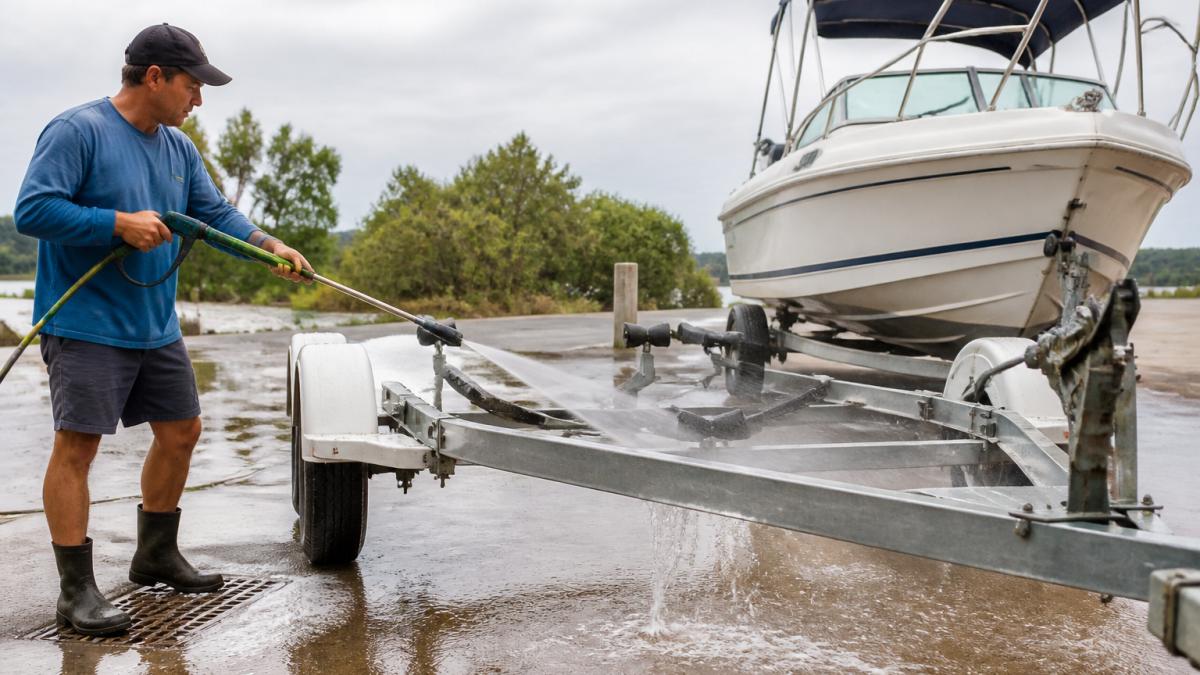
Freshwater rinse and pressure washer technique
A freshwater rinse removes salt before it dries and bonds to the metal, at the ramp if possible, or as soon as you get home.
The routine:
- Rinse the whole frame, not just the visible parts
- Flush inside the rails and around the axle
- Use a pressure washer on low-to-medium setting
High pressure in one spot blasts through galvanising; medium pressure with a wide fan tip cleans without damage.
Drying the trailer frame to stop flash rust
Flash rust forms on wet steel within hours. Drying is not optional.
- Use a microfiber cloth on accessible surfaces
- Blow compressed air into enclosed sections
- Tilt the trailer so water drains from the rails
Choosing a Marine Anti-Corrosion Spray for Metal Components
A marine anti-corrosion spray for metal adds a barrier salt water can't easily penetrate. It's the second line of defence after cleaning, and the layer most kit builders get wrong.
How the main product families actually work
Not all inhibitors behave the same way on a trailer frame; the mechanism tells you where each belongs.
- Lanolin-based sprays leave a soft, waxy film that displaces water and creeps into seams. They self-heal to a degree, so a small scratch doesn't open a bare patch. The trade-off is that the film stays tacky and attracts dust and sand, which is a problem on a trailer that gets dunked at a sandy ramp.
- Wax-based coatings dry to a harder, drier film. They resist wash-off better than lanolin and don't hold grit, but they don't creep as far into tight joints, so they work best on open surfaces you can reach directly.
- Petroleum-based inhibitors penetrate rust and displace moisture well, which makes them useful on fasteners and threads. They wash off faster than wax, so they need more frequent reapplication.
A common pattern is two products: a creeping lanolin or petroleum inhibitor for hidden joints and threads, and a harder wax or zinc-rich coating for exposed surfaces.
Matching the product to the surface
Surface |
Suitable product |
Avoid |
Why |
|---|---|---|---|
Galvanised steel |
Lanolin-based spray, zinc-rich touch-up |
Solvent-heavy sprays that strip zinc |
Solvents remove the very layer doing the protecting |
Painted steel |
Wax-based protective coating |
Harsh degreasers |
Degreasers lift paint edges and let water underneath |
Aluminium |
Aluminium-safe inhibitor |
Copper-based products |
Copper and aluminium set up galvanic corrosion |
Threads and U-bolts |
Marine grease or petroleum inhibitor |
Thin oils that wash off |
Thin films disappear after one or two launches |
Welds |
Zinc-rich coating |
Wax-only products |
Welds need sacrificial protection, not just a barrier |
Application safety and surface prep
A coating applied over salt, oil, or loose rust fails early. The prep matters as much as the product.
- Wash and dry the surface first. Any salt left under the film keeps working on the steel.
- Remove loose rust and flaking coating with a wire brush. You don't need bare metal, but you do need a sound surface.
- Work in a ventilated area, away from ignition sources. Most of these products are flammable in aerosol form.
The Australian Standard for protective coatings on steel structures sets out how coating systems are classified, which helps when comparing products on a spec sheet rather than a label.
Material-Specific Care: Galvanised Steel, Painted Steel and Aluminium
Each material fails differently, so each needs a different approach, especially on a kit build, where you handle bare components before assembly.
Galvanised steel
Galvanising works by sacrificial protection: the zinc layer corrodes in preference to the steel underneath, so the steel stays intact.
The failure points are predictable:
- Welds. The heat of welding burns off the zinc locally, leaving bare steel. This is the single most common first rust site on a galvanised trailer.
- Cut edges and drilled holes. A sheared or drilled edge exposes bare steel with no zinc coverage.
- Bolt holes and U-bolt contact points. Movement and moisture combine to wear through the coating.
For a kit build, treat every weld, cut edge, and drilled hole before assembly. A zinc-rich coating restores sacrificial protection at those points. Once the trailer is together, check welds every few months and touch up any that show white or red corrosion.
Painted steel
Painted steel fails from the edges inward: a chip or scratch lets water reach the steel, rust starts under the paint film and lifts it from below. By the time you see bubbling, corrosion has spread sideways under intact-looking paint.
For kit components:
- Touch up every chip and scratch immediately, not at the end of the season.
- Feather the edges of a chip before painting so the new coat bonds to sound paint, not to a lifted edge.
- Use a primer designed for bare steel under the topcoat. Paint alone doesn't stop rust on a bare scratch.
A painted trailer needs more frequent inspection than a galvanised one because the failure is hidden until it's advanced.
Aluminium
Aluminium doesn't rust like steel, but it corrodes. Its natural oxide layer protects it, which is why bare aluminium often looks fine for years; problems start when that layer is disrupted or the aluminium touches a dissimilar metal.
Watch for:
- White powdery deposits. This is aluminium oxide or hydroxide, the aluminium equivalent of rust.
- Pitting. Small pits that deepen over time, often under dirt or salt deposits that hold moisture against the surface.
- Galvanic corrosion at dissimilar-metal joints. Where aluminium meets stainless steel or galvanised steel, and moisture bridges the gap, the aluminium becomes the sacrificial anode and corrodes fast. This is a real risk on kit trailers that mix aluminium components with steel fasteners.
For aluminium components:
- Keep the surface clean and free of salt and dirt buildup.
- Use an aluminium-safe inhibitor. Copper-based products are the wrong choice because copper accelerates galvanic attack on aluminium.
- Isolate aluminium-to-steel joints with a barrier, a nylon washer, a plastic shim, or a dedicated isolating compound, so the two metals don't touch directly.
Reaching Hidden Areas: Internal Frame Coating, Fasteners and Threads
Hidden areas cause the worst rust because you can't see it coming; by the time it shows outside, the inside is often too far gone.
Focus on:
- Internal frame sections and enclosed rails
- Welds on the underside of the frame
- U-bolts holding the axle and springs
For enclosed sections, use an internal frame coating applied with a flexible wand. For fasteners, marine grease on exposed threads and U-bolts creates a barrier that salt can't cross.
Reapply grease every few months. It washes off slowly with repeated launching.
Your Boat Trailer Maintenance Checklist for Year-Round Protection
A repeatable schedule beats occasional deep cleans. Here's a boat trailer maintenance checklist you can stick to.
Frequency |
Task |
Why it matters |
|---|---|---|
After every trip |
Freshwater rinse and dry |
Removes salt before it bonds |
Monthly |
Inspect welds, U-bolts, threads |
Catches surface rust early |
Every 3 months |
Re-grease fasteners and threads |
Replaces washed-off barrier |
Every 6 months |
Reapply anti-corrosion spray |
Refreshes protective coating |
Annually |
Full inspection and touch-up |
Finds hidden corrosion |
Pair this with a marine safety checklist from the Australian Maritime Safety Authority so your trailer and your vessel stay in step.
Assessing and Treating Existing Rust Before It Spreads
Existing rust won't fix itself and spreads faster than most owners expect; caught early, treatment is quick.
Start by assessing the damage:
- Surface rust: orange-brown, sits on top of the metal. Treat with a rust remover, then re-coat.
- Scale rust: flaky, lifts off in layers. Grind back to bare metal, then apply a rust encapsulator.
- Deep rust: pitting or holes in the steel. This needs a welder, not a spray can.
For surface and scale rust:
- Clean the area with a wire brush or grinder
- Remove all loose rust and old coating
- Wipe down and let it dry
- Apply a rust encapsulator or converter
- Top with a protective coating
If you're heading out on the water, a marine first aid guide from the Department of Health is worth keeping on board alongside your trailer maintenance kit. PFA Shop stocks marine-specific first aid kits built for the same saltwater conditions that attack your trailer, so your safety gear holds up as well as your frame.
Frequently Asked Questions
How often should you rinse boat kit components after use in salt water?
Rinse every time the boat kit or trailer comes out of salt water, ideally within a few hours of retrieval. Salt crystals draw moisture from the air and start attacking bare steel and welds quickly, so a freshwater rinse on the same day makes a real difference. If you launch regularly, a full washdown with a pressure washer once a week and a deeper clean monthly will keep salt buildup from settling into frame sections, U-bolts and threads.
What coating is best for protecting boat kit metal from rust?
It depends on the metal. Galvanised steel benefits from a lanolin-based or wax-based marine anti-corrosion spray that soaks into the zinc surface. Painted steel needs a barrier coating over intact paint, plus touch-ups wherever the paint has chipped. Aluminium does not rust the same way but still corrodes, so an anti-corrosion spray designed for mixed metals works well. For enclosed frame sections, use a cavity wax or internal frame coating applied through a spray wand.
Can you use WD-40 to prevent rust on boat kit parts?
WD-40 displaces water and gives short-term protection, which makes it useful for a quick wipe-down on threads and fasteners after a rinse. It is not a long-term barrier, though. It washes off with repeated saltwater exposure and needs reapplying often. For lasting protection on a trailer frame, use a dedicated marine anti-corrosion spray or a rust encapsulator over prepared surfaces, and reserve WD-40 for loosening seized bolts or a fast interim wipe.
What is the difference between rust prevention and rust removal?
Rust prevention stops corrosion before it starts, using rinsing, drying, coatings and regular inspection to keep oxygen and salt away from bare steel. Rust removal treats corrosion that is already there, usually by sanding, wire brushing or applying a rust converter, then sealing the surface with paint or a rust encapsulator. On a boat trailer, you need both: remove any surface rust you find, then apply a protective coating so it does not return.
Rust on boat kits is a habit problem, not a materials problem. Rinse, dry, inspect, and re-coat on a schedule, and your trailer will outlast most of the boats it carries. PFA Shop supplies marine-ready safety equipment and first aid kits designed for coastal conditions, with specialised kits for boat owners, workplaces, and events. Browse our range and get the right gear before your next trip.