
Is a Boat Safety Gear Bundle Worth It for Family Trips?
Last Updated: November 1, 2026
Quick Summary
A boat safety gear bundle is worth it for family trips when its contents match your vessel, crew size and trip length, since it saves time and reduces the chance of forgetting critical gear. For most families on inshore runs, the Scale G covers the legal and practical essentials at the lowest entry price, while coastal and offshore families should look at the Scale E.
- A bundle does not replace checking expiry dates, sizing PFDs and confirming signaling gear meets your vessel class requirements.
- Fit PFDs by weight first, then check chest and torso coverage, and do the arms-up test on the pontoon.
- Short inshore runs with 2-3 people need PFDs, a compact first aid kit, whistle, torch and one dry bag.
- The Scale G costs $282.35 and suits private boats doing day trips and short coastal runs.
- The SUPERDAD 2 Series at $39.99 is a weatherproof secondary kit sized 21 x 7.5 x 13 cm.
Table of Contents
- What a Boat Safety Gear Bundle Actually Covers
- Boat Safety Equipment Checklist for Family Trips
- Marine First Aid Kit Options Compared
- Building a Boat Emergency Kit by Trip Length and Passenger Count
- Choosing a Waterproof First Aid Kit for Boating
- Inspection, Expiry Dates and Maintenance Schedules
- Pricing Breakdown and Total Cost of Ownership
- Match Your Kit to Your Vessel and Crew Size
- Frequently Asked Questions
What a Boat Safety Gear Bundle Actually Covers
A boat safety gear bundle is a pre-assembled set of essential safety equipment, typically combining first aid supplies, signaling devices, and storage into one purchase.
The catch is that "bundle" means different things depending on the seller. Some are first aid kits with a marine label; others are genuine compliance packs built to the National Standard for Commercial Vessels. Knowing which you're buying changes whether it's worth the money.
Boat Safety Equipment Checklist for Family Trips
Every family trip needs the same core categories, regardless of vessel size, but what matters is how each item is sized, fitted, and verified for the people on board. Use this as your working checklist before any launch:
- Life jackets and personal flotation devices (PFDs) sized to each passenger by weight and chest measurement, including children
- Marine first aid kit with dressings, bandages, and burn treatment scaled to passenger count and trip length
- Fire extinguisher rated for marine use and within its service date
- Distress flares or an electronic flare within expiry
- Signaling device including a safety whistle and torch with spare batteries
- Emergency SOS device such as an EPIRB or PLB where required
- Dry bags and waterproof storage for phones, documents, and spare clothing
- Safety kit extras: knife, rope, bailer, and a fuel storage plan
A boat safety gear bundle may cover some of these items. Verify the rest yourself.
Sizing and fitting PFDs for adults and children
PFDs are the one item where a near-enough fit is not good enough. A child in an adult PFD can slip out or float face-down, and an adult in a too-small jacket cannot close the front properly. Fit by weight first, then check chest and torso coverage.
Legal requirements vary by vessel, distance from shore, and state
Required equipment depends on vessel type, length, distance from shore, and state or territory, so check the rules that apply where you boat.
Rather than guess, verify before you buy:
- Identify your vessel type and length, and the maximum distance from shore you plan to travel.
- Check the marine safety agency for the state or territory where you launch for its recreational boating safety equipment requirements.
- Confirm the PFD type and level required for your operating area.
- Check flare type and expiry rules for your waters.
- Keep a copy of the checklist on board.
Scale the checklist to passenger count and trip length
A two-hour river run with two adults needs far less than a full day offshore with four children. As a rule of thumb:
- Short inshore run (2-3 people, under 2 hours): PFDs for all, a compact first aid kit, whistle, torch, one dry bag.
- Full day coastal (4-6 people): PFDs for all, a mid-range first aid kit, flares within expiry, whistle, torch, two dry bags, drinking water for the day.
- Offshore or overnight (4+ people): PFDs for all, a comprehensive first aid kit, EPIRB, flares, torch with spares, dry bags plus a fixed locker, and a written float plan left with someone ashore.
Passenger count adds a sizing question for PFDs more than anything else, and trip length drives first aid depth and signaling redundancy. Build the checklist around those two variables and the bundle contents become much easier to judge.
Marine First Aid Kit Options Compared
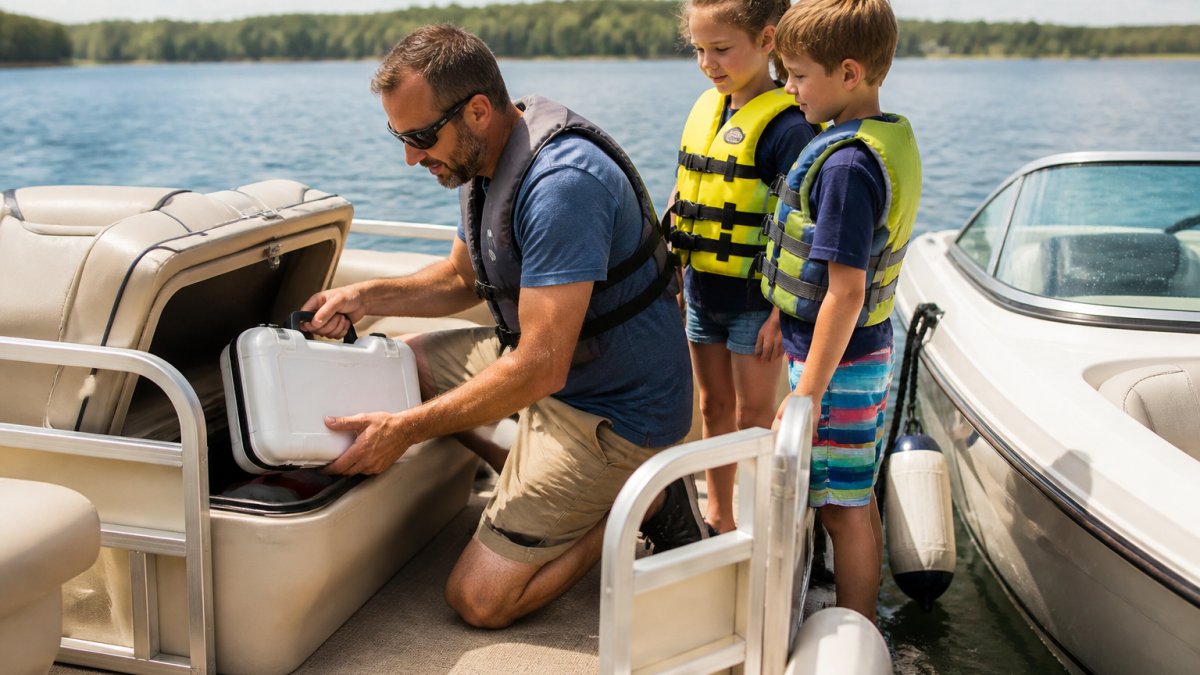
The first aid kit is the heart of any bundle. For a wider view, our marine-grade first aid kit comparison breaks down the full range.
NAVIGATOR Scale G: The Entry Compliance Kit
The Scale G is the sensible starting point for most families. At $282.35, it is configured for specified NSCV vessel classes, and its listing describes use for common injuries such as cuts, grazes and minor burns.
Best for: families on private boats doing day trips and short coastal runs. Skip if: you operate commercially or head well offshore.
You can view the NAVIGATOR Scale G marine first aid kit for the full contents list.

NAVIGATOR Scale F and Scale D: Mid-Range Coverage
The Scale F is priced at $339.99 and is listed for commercial passenger vessels, fishing boats and charter craft. The Scale D, at $379.99, has a briefcase-style case with a carry handle.
The real difference between these two comes down to case format and how you plan to stow it. If you have a fixed wheelhouse wall, either works. Check Scale F product details before you commit.

NAVIGATOR Scale E: Full Commercial-Grade Coverage
At $379.99, the Scale E is listed for passenger vessels and commercial craft. It has a rigid UV-resistant shell and a water-resistant seal to help protect contents from water, sun and salt air.
Best for: larger family boats, offshore trips, and anyone who wants no gaps. Skip if: you only ever do short inshore runs.
NAVIGATOR Scale E Marine First Aid Kit 42.8 x 30.4 x 14.6cm →
See the full Scale E specification if you need the top tier.

Building a Boat Emergency Kit by Trip Length and Passenger Count
Trip length and headcount drive what your boat emergency kit needs to hold. Here's how we'd plan it:
Trip Type |
Passengers |
First Aid Depth |
Signaling |
Storage |
|---|---|---|---|---|
Short inshore run |
2-3 |
Scale G |
Whistle, torch |
One dry bag |
Full day coastal |
4-6 |
Scale F or D |
Flares, whistle, torch |
Two dry bags |
Offshore or overnight |
4+ |
Scale E |
EPRIB, flares, torch |
Dry bags plus fixed locker |
As trip length grows, planning typically calls for more first aid coverage and signaling redundancy.
Choosing a Waterproof First Aid Kit for Boating
Waterproofing matters for boat kits. The NAVIGATOR marine kits use a UV-resistant hard case with a water-resistant seal.
For a small secondary kit, the SUPERDAD 2 Series at $39.99 is a weatherproof option with protection against water and dust, sized at 21 x 7.5 x 13 cm. For a deeper look at sealing and storage, our waterproof first aid kits for boats guide covers the trade-offs.
Inspection, Expiry Dates and Maintenance Schedules
A bundle is only worth the money if you maintain it, and maintenance is where most family boats quietly fail. Set a recurring reminder and work through a fixed checklist rather than a vague look in the locker.
The pre-departure check
Run this before every trip, and assign each item to a named adult so nothing is assumed:
- PFDs: check buckles, straps, and stitching; confirm the level marking matches your operating area; do the arms-up fit test on each child.
- Flares and electronic flares: check expiry dates and battery status; replace pyrotechnics before the printed date, not on it.
- EPIRB or PLB: check the battery expiry and run the self-test according to the manufacturer's schedule (Looking after your beacon).
Expiry and replacement cycle
Flares and sterile dressings can expire, so check their dates regularly. Replace flares on a fixed cycle and rotate first aid stock at the same time, so you are not making two separate trips to the chandlery. Budget for replenishment from day one rather than treating it as an unexpected cost.
Emergency scenarios and family roles
Knowing what each person does when something goes wrong matters as much. Brief the crew before launch, with age-appropriate roles for children:
- Man overboard: the adult at the helm stops the boat and keeps the person in sight; another adult throws a float and points; children are taught to shout "man overboard" and point, not to jump in.
- Fire: adults use the extinguisher and shut off fuel; children move to the bow and stay low; everyone knows the location of the extinguisher and the VHF or phone.
- Injury: the first aid kit is retrieved by a named adult; children are taught to stay seated and call for help rather than crowd the casualty.
Pricing Breakdown and Total Cost of Ownership
Here's what the four NAVIGATOR kits cost:
Kit |
Price (AUD) |
Best Use |
|---|---|---|
Scale G |
$282.35 |
Inshore family trips |
Scale F |
$339.99 |
Coastal and charter use |
Scale D |
$379.99 |
Portable mid-range coverage |
Scale E |
$379.99 |
Commercial-grade coverage |
Total cost of ownership adds replacement stock and expiry cycling over the kit's life. A cheaper kit that needs constant topping up often costs more than a well-stocked one. Budget for replenishment from day one.
Match Your Kit to Your Vessel and Crew Size
The right boat safety gear bundle for family trips is the one that matches your actual vessel and crew, not the biggest box on the shelf.
A bundle saves time and reduces the chance of forgetting something critical. It does not replace your responsibility to check expiry dates, size the PFDs, and confirm your signaling gear meets the requirements for your vessel class.
Frequently Asked Questions
What safety equipment should be on a boat for a family trip?
At minimum, carry a life jacket or PFD sized to each person on board, including children, plus a distress signaling device, a fire extinguisher, a torch, a safety whistle and a marine first aid kit. Add a dry bag or waterproof storage pouch for documents and phones, and check your state's marine safety agency rules, since required items vary by vessel type and the waters you use. Family trips also call for spare clothing and sun protection, which are not legal requirements but matter in practice.
What should a marine first aid kit contain for a family boat?
A marine first aid kit should cover cuts, grazes, burns, eye irritation and sprains. The NAVIGATOR Scale G Marine First Aid Kit at $282.35 is the entry point in the range, while the Scale E and Scale D kits are priced at $379.99. Store the kit in a hard case with a water-resistant seal.
How often should boat safety equipment be checked?
Check your boat safety gear before every trip. Look at expiry dates on flares, sterile dressings and any medication, test torches and electronic signaling devices, and confirm life jackets still fit each family member, especially children who grow quickly. Replace anything expired or damaged immediately rather than waiting for the next scheduled check.
How should boat safety gear be stored to keep it dry and accessible?
Keep first aid supplies in a hard case with a water-resistant seal, in a visible spot on board. Store flares, torches and whistles in a separate dry bag or waterproof storage pouch that is easy to grab. Avoid lockers that collect water, and label each container so anyone on board can find it fast. A fixed location also makes it obvious when something has been removed and needs replacing.
Building a genuinely compliant safety setup takes more than one purchase. PFA Shop supplies marine-specific first aid kits built to NSCV requirements, with UV-resistant cases, water-resistant seals, and wall-mount brackets that keep gear accessible when it counts. Browse the NAVIGATOR range and get your family's kit sorted before the next trip.
