
Best First Aid Kit for Australian Horse Riders: A Practical Guide
Last Updated: November 7, 2026
Quick Summary
The best first aid kit for Australian horse riders treats both horse and rider, suits your riding conditions, and stays stocked and in date. Most equine emergencies happen far from the vet or nearest town, so choose a kit by where you ride and how far you are from help.
- A complete horse kit covers five jobs: cleaning wounds, covering them, wrapping limbs, monitoring vital signs and contacting help.
- The AEROKIT 3 Series Modulator Mini Softpack costs $159.99 and has five colour-coded, replaceable modules.
- Trail riders should add the REGULATOR Premium Snake & Spider Bite Kit ($44.00) for venomous bites and stings.
- Store kits dry, out of direct sun, and check them at the start of every season and after every use.
- Call the vet immediately for deep wounds, uncontrolled bleeding, colic signs, snake bites or eye injuries.
Table of Contents
- What Australian Horse Riders Need in a First Aid Kit
- The Horse First Aid Kit Checklist
- Ready-Made Kits Versus Building Your Own
- The Human First Aid Kit for Horse Riders
- A Horse First Aid Kit for Trail Riding
- How to Store a Horse First Aid Kit
- When to Call the Vet and What to Do While You Wait
- Choosing Your Equine First Aid Kit
- Frequently Asked Questions
What Australian Horse Riders Need in a First Aid Kit
The best first aid kit for Australian horse riders is one that treats both the horse and the rider, fits the conditions you actually ride in, and stays stocked and in date. Most equine emergencies happen far from the float, the vet or the nearest town, so a kit needs to be ready before you leave.
A horse first aid kit is a dedicated collection of wound care, bandaging and monitoring supplies kept close to where you ride and stable your horse. It differs from a human kit because the injuries differ: horses suffer wire cuts, puncture wounds and leg lacerations that need large dressings and firm wraps.
Below, we break down what goes in each kit, how ready-made options compare, and how to store everything so it works when you need it.
The Horse First Aid Kit Checklist
A complete horse first aid kit checklist covers five jobs: cleaning wounds, covering them, wrapping limbs, monitoring vital signs, and contacting help. Build your kit around those jobs and you will cover the vast majority of situations you can manage yourself.
Wound Cleaning and Antiseptic Supplies
Wound cleaning comes first, and it is where most kits fall short. You need saline solution for flushing dirt and debris from cuts and grazes, plus an antiseptic solution or antiseptic scrub for cleaning the skin around a wound. Add skin cleansing wipes for hands and small areas, and wrapped sterile plasters for the rider's own minor cuts.
Watch out: never reuse a diluted antiseptic beyond its stated life. Flush with saline, clean the edges, then cover.
Bandages, Dressings and Cohesive Wraps
Bandaging basics decide whether a wound stays clean on the float ride home. Stock sterile dressings and gauze for covering, conforming bandages for holding dressings in place, and cohesive bandages or a compression wrap for support and emergency bandaging. Include a wound covering for larger areas and a wound spray where your vet recommends one.
The common mistake is buying only small dressings. A leg laceration can need a dressing far larger than a standard plaster, so check sizes before you ride out.
Thermometers, Saline and Monitoring Tools
Monitoring tools turn guesswork into useful information for your vet. A digital thermometer lets you record temperature, and a basic set of instruments, scissors and forceps included, helps you work safely. Saline does double duty for wound and eye rinsing, so keep a generous supply.
Record what you find: temperature, time, and what you did. Your vet will ask.
Ready-Made Kits Versus Building Your Own
Ready-made kits win on speed and completeness; building your own wins on control. For most riders, a ready-made kit plus a few additions is the practical choice.
A ready-made kit arrives organised, labelled and complete, which matters when you are stressed. Building your own lets you match every item to your horse and your terrain, but it takes research and you can easily miss something critical.
Our AEROKIT 3 Series Modulator Mini Softpack First Aid Kit ($159.99) is a colour-coded kit with modules for burns and eye wounds, twists and sprains, stings and snakebites, cuts and scrapes, plus a personal essentials pouch. It is workplace compliant for low-risk environments and individual modules can be replaced as they are used.
For a simpler setup, the DEFENDER 3 Series Softpack Versatile First Aid Kit ($54.99) covers everyday cuts, grazes, sprains and burns in a compact soft case that stands upright for quick access.
The Human First Aid Kit for Horse Riders
A human first aid kit is worth carrying alongside your horse kit, since a rider on the ground may need care as well.
Keep a separate human kit with wrapped sterile plasters, cleansing wipes and dressings. The DEFENDER 3 Series Softpack Versatile First Aid Kit covers everyday cuts, grazes, sprains and burns in a compact case.
Store the human kit where you can reach it without moving the horse. If a rider is injured, the horse becomes a hazard, not a helper.
A Horse First Aid Kit for Trail Riding
A horse first aid kit for trail riding must be compact, hands-free and built for venomous bites. Weight and bulk matter over distance, so choose a kit that clips on or packs flat.
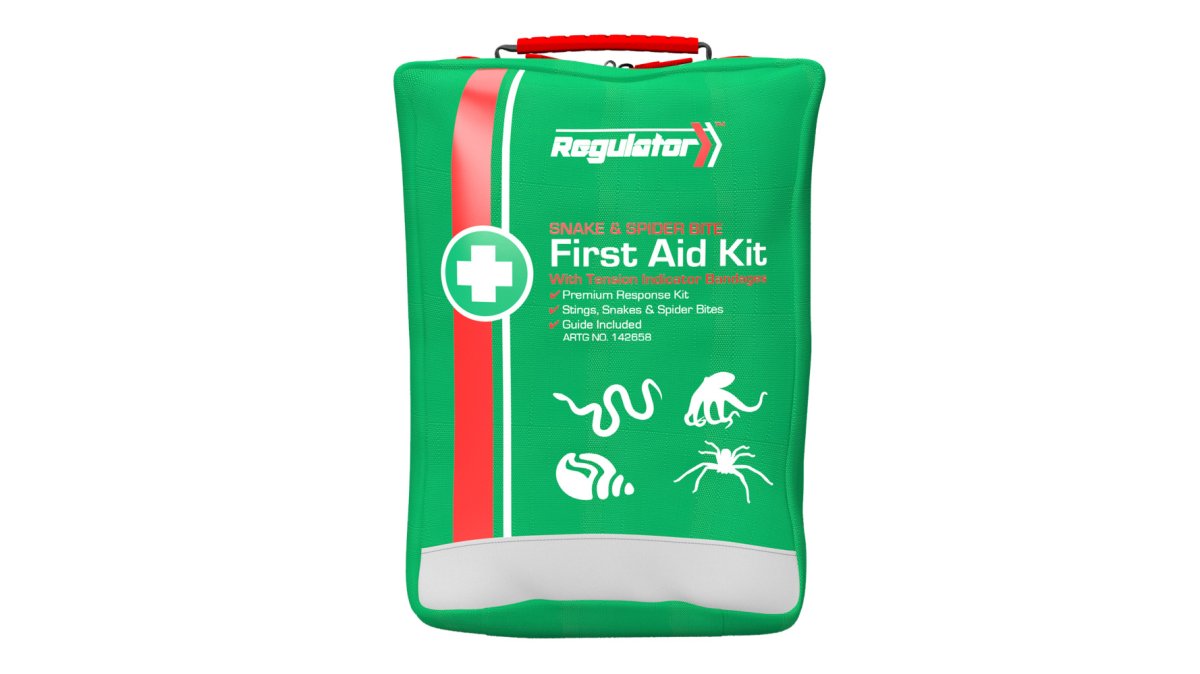
The REGULATOR Premium Snake & Spider Bite Kit ($44.00) is designed for venomous bites and stings. It uses pressure immobilisation bandages with integrated tension indicators and suits bushwalking, camping, farming and remote work, and its softpack can be carried in a backpack or stored in a 4WD.

The VOYAGER 2 Series Bumbag First Aid Kit ($43.99) is an easy-to-carry bag that clips around the waist for accessible first aid items. If you are building a kit from scratch, our guide to the first aid supplies every kit needs covers the essentials.

Best for: riders covering long distances where weight and access matter. Skip if: you ride only in an arena and keep a full kit at the gate.
How to Store a Horse First Aid Kit
Storage matters in Australian conditions. Heat, humidity and dust can affect dressings and adhesives, so store a kit somewhere dry and check it regularly.
Manage heat deliberately. Store the kit in the coolest part of the float or vehicle, out of direct sun, and bring it inside during heatwaves where practical.
Control moisture and dust. Wipe the inside of the case each season, and avoid storing damp bandages against the kit.
Keep it reachable in seconds. The kit should live where you tack up or where you load, not buried under feed bins.
Set a restocking rhythm. Check the kit at the start of every season and after every use. Our guide to tracking first aid expiry dates walks through a simple system.
Watch out: a kit that has been through a summer in a closed float may look intact but have degraded adhesive and compromised sterile packaging, so inspect and replace rather than assume.
Our waterproof first aid kit range covers hard-case options for damp, dusty or vehicle-based storage, and the AEROKIT 2 Series Plastic Waterproof First Aid Kit ($40.25) is a practical example of a sealed case with a refill pouch system that lets you restock without unpacking everything.

When to Call the Vet and What to Do While You Wait
Knowing when to call is only half the job.
Have the information ready before you dial. Your vet will ask for the horse's temperature, heart rate, respiratory rate, gum colour, capillary refill time and the time the injury occurred.
Write the plan inside the kit. Include your vet's after-hours number, the nearest 24-hour equine hospital, the nearest property or road access point for your regular trails, and a second contact who can bring a float.
What to do while you wait. Keep the horse calm and still, control bleeding with firm direct pressure through a sterile dressing, and do not remove an impaled object.
Plan for distance. If you ride remotely, carry a communication backup such as a personal locator beacon or satellite messenger, and know which direction the nearest road access lies.
Watch out: record anything you give your horse and when, so you can tell your vet.
For suspected snake bite, follow the first aid guidance supplied with your kit and contact your vet.
Choosing Your Equine First Aid Kit
Choose by where you ride and how far you are from help. Arena riders need a solid barn kit; trail riders need a portable kit plus a snake bite kit; competitive riders need both.
| Rider type | Kit to start with | Price | Why |
|---|---|---|---|
| Arena and stable | DEFENDER 3 Series Softpack | $54.99 | Covers everyday cuts, grazes, sprains, burns |
| Trail and remote | REGULATOR Premium Snake & Spider Bite Kit | $44.00 | Pressure immobilisation with tension indicators |
| Hands-free carry | VOYAGER 2 Series Bumbag | $43.99 | Clips to the waist, essentials within reach |
| Full coverage | AEROKIT 3 Series Modulator Mini | $159.99 | Five colour-coded modules, replaceable |
| Damp storage | AEROKIT 2 Series Waterproof | $40.25 | Hard case, refill pouch system |
Price
Whatever you choose, add a dedicated snake bite kit if you ride where snakes are active. The AEROKIT Snake Bite First Aid Softpack ($24.99) includes two snake bite bandages and a reflective strip for easy access.
Every rider plans for the good days. The challenge is being ready for the bad one, when a wire cut or a snake bite happens an hour from the float. PFA Shop stocks equine and rider first aid kits with clinical-grade, latex-free contents, modular designs you can restock, and purpose-built snake bite kits with tension-indicator bandages. Build your kit around where you actually ride, check it each season, and you will be ready. Get started with PFA Shop and ride out with a kit that works.
Frequently Asked Questions
What should be in a horse first aid kit?
A workable kit covers wound cleaning, wound covering and monitoring. Include antiseptic solution or scrub, saline for rinsing wounds and eyes, gauze swabs, sterile dressings, cohesive bandages and a compression wrap, plus a thermometer, scissors, gloves and a written vet contact list. Australian riders should also carry a dedicated snake bite kit with pressure immobilisation bandages, because venomous snakes are a real risk on trails and rural properties. Restock anything used straight away so the kit is complete before the next ride.
What should horse riders carry in a human first aid kit?
Riders fall too, so pack for the person as well as the horse. A human first aid kit for horse riders should hold wrapped sterile plasters, cleansing wipes, a conforming bandage, a triangular bandage, an instant cold pack, gloves and a foil emergency blanket. Add personal items such as any medication you take and a charged phone. Keep it in your saddlebag or on your belt rather than in the float, so it is with you if you come off miles from the car.
What is the best first aid kit for trail riding?
The best option is compact enough to carry and focused on likely injuries. A trail kit should cover minor wounds, cuts and grazes, plus snake bite, so look for a softpack with bandages, dressings, saline and pressure immobilisation bandages. A bumbag or belt-mounted kit keeps supplies on your body if your horse gets loose. Pair it with a fuller kit in the float for anything that needs more supplies once you are back at the vehicle.
How should you store and maintain an equine first aid kit?
Store the kit somewhere dry, cool and easy to reach, such as a tack room shelf or the float, not a damp corner where bandages go mouldy. Keep it in a labelled case so anyone can find it in a hurry. Check it every three months: read expiry dates on antiseptics, saline and dressings, replace anything opened or expired, and confirm the vet numbers are current. After any use, restock immediately so the kit is never half empty when you need it.
Should a horse first aid kit include a tourniquet or bleed-control supplies?
For serious bleeding, pack pressure dressings and a compression wrap, and use firm direct pressure while you call the vet. A windlass tourniquet is not routine equipment for horses and should only be used on veterinary advice, because improper use can cause lasting damage. Focus your kit on sterile dressings, gauze and cohesive bandages for wound covering, and treat uncontrolled bleeding as an emergency. Call your vet immediately and follow their instructions while you apply pressure.
