
Best Enhanced Emergency Preparedness for Marine First Aid
Last Updated: November 8, 2026
Quick Summary
The best enhanced emergency preparedness for marine first aid is matching your kit to trip length, crew size and distance from shore, then adding advanced capability such as a bleed control pack and an AED for offshore work. Set a monthly check and quarterly audit so supplies stay in date and accessible.
- Navigator Scale G is listed at $282.35 and Scale F at $339.99, each in a 42.8 x 30.4 x 14.6 cm hard case.
- Every kit needs bleeding control, wound cleaning, burns, eye injury and immobilisation categories, plus gloves in multiple sizes.
- Offshore passages add a haemostatic dressing, splint, broader medications and a written log for monitoring the patient.
- The Defibtech Fully Automatic Defibrillator AED Waterproof Bundle is listed at $2,670.00 with Pelican case, rescue kit and signage.
- Run a monthly check and deeper quarterly audit, replacing used items immediately rather than at season's end.
Table of Contents
- How Marine First Aid Kit Requirements Shape Your Choice
- Comparing Navigator Marine First Aid Kits by Scale
- The Boat First Aid Kit Checklist That Covers Real Emergencies
- Advanced Marine First Aid Capability Beyond the Basics
- Marine First Aid Kit Maintenance and Expiry Management
- Onboard Emergency Response and Delayed Medical Help
- Choosing the Right Marine First Aid Kit for Your Vessel
- Frequently Asked Questions
How Marine First Aid Kit Requirements Shape Your Choice
Marine first aid is the practice of carrying and maintaining medical supplies suited to injuries that happen on water, where help is far away and conditions are harsh. Boat owners often buy a generic kit, then discover it lacks the dressings, irrigation gear and protection needed when a real incident occurs offshore. Requirements vary with vessel class, crew size and distance from shore, so a compliant kit for an inshore workboat differs from what a charter skipper needs. Australian operators should also check the National Standard for Commercial Vessels guidance before purchasing, because kit contents are tied to vessel class rather than personal preference.
Comparing Navigator Marine First Aid Kits by Scale
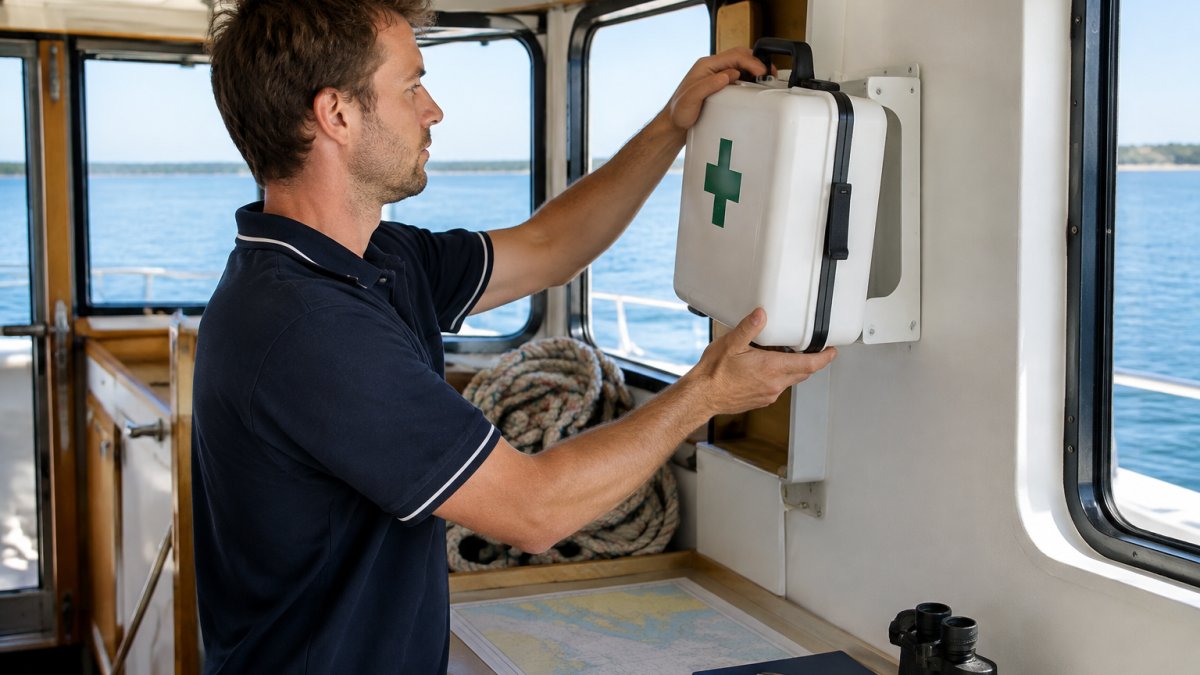
Navigator kits are built around vessel scale, and our range reflects that structure. The Scale G is listed at $282.35 and the Scale F at $339.99. The Scale D and Scale E are each listed at $379.99. Each kit is supplied in a 42.8 x 30.4 x 14.6 cm hard case. For a fuller side-by-side breakdown, see our comparison of marine-grade first aid kits.
| Kit | Price | Best For | Compliance |
|---|---|---|---|
| Scale G | $282.35 | Inshore and enclosed waters | NSCV Scale G |
| Scale F | $339.99 | Passenger vessels, charters | NSCV Scale F |
| Scale D | $379.99 | Commercial and serious recreational | NSCV indicated class |
| Scale E | $379.99 | Passenger vessels, larger private boats | NSCV indicated class |
Price
The Boat First Aid Kit Checklist That Covers Real Emergencies
A boat first aid kit checklist should cover bleeding control, wound cleaning, burns, eye injuries and immobilisation. In practice, most kits fail on three items: enough gauze for a serious bleed, sterile saline for irrigation, and gloves in the right sizes. Check for dressings, bandages, tapes, antiseptic, sterile saline and eye wash, gauze, disposable gloves, a CPR barrier, an emergency blanket, cold packs, tweezers and scissors. Add sun protection and hydration supplies for long days on deck. Store everything in waterproof storage, and confirm the kit is accessible without moving gear.
That baseline is where most checklists stop, and it is why so many kits come up short on the water. A checklist that actually covers real emergencies is built around three variables: trip length, crew size and distance from shore. Use the categories below as a starting point, then scale the quantities to match your voyage.
Core categories every kit needs
- Bleeding control: gauze swabs, combine dressings, crepe bandages, conforming bandage, tape, and a haemostatic dressing for severe bleeding
- Wound cleaning: sterile saline ampoules, antiseptic wipes, irrigation syringe, and eye wash
- Burns: burn gel dressing, cling film, and cold packs
- Eye injuries: eye pad, eye wash, and a mirror or second person to help irrigate
- Immobilisation: triangular bandages, splint, and cervical collar where the kit allows
- Protection: disposable gloves in multiple sizes, CPR barrier, and a resuscitation mask
- Comfort and monitoring: emergency blanket, thermometer, and a notebook and pen for logging times and observations
- Sun and hydration: sunscreen, oral rehydration sachets, and water
How trip length changes the checklist
A day trip in enclosed waters needs the core categories plus enough gauze and saline for one or two incidents. An overnight voyage adds a second set of gloves, extra dressings, a larger saline supply, and a means of keeping the patient warm through the night. An offshore passage adds a haemostatic dressing, a splint, a wider range of medications for seasickness and pain, and a written log for monitoring a patient over many hours. The principle is simple: the further you are from help, the more you need to be able to treat, monitor and hand over without resupply.
How crew size changes the checklist
Two people on an inshore boat can carry a compact kit. A charter with eight passengers needs more gloves, more dressings, and a kit that one person can hand to another without repacking. Larger crews also justify a second smaller grab kit kept near the helm, so the main kit does not have to be fetched from below deck while someone is bleeding.
How distance from shore changes the checklist
Inshore, the checklist can assume help arrives within an hour. Offshore, it must assume help is hours or days away. That shift adds a bleed control pack, an AED where the vessel can carry one, a broader medication set, and a written handover sheet so a patient's condition can be passed to a professional cleanly.
What to check before every trip
Open the kit, confirm the seal is intact, check that gloves are the right sizes for the crew aboard, and confirm the saline and antiseptic are in date. Confirm the kit is accessible without moving gear. Watch out: a kit that is technically complete but buried under fenders and rope is not accessible, and accessibility is the item most often missed on a checklist.
For a fuller side-by-side breakdown of how our kits map to these categories, see our comparison of marine-grade first aid kits.
Advanced Marine First Aid Capability Beyond the Basics
Standard kits handle cuts and sprains. Serious bleeding needs more, and that is where advanced marine first aid capability matters. Our Rapidstop Medium Bleed Control Pack is built for that scenario. Sudden cardiac arrest is the other gap. The Defibtech Fully Automatic Defibrillator AED Waterproof Bundle is listed at $2,670.00 and includes a Pelican case, rescue kit and signage. Watch out: an AED stored below deck and never checked is worse than no plan at all, so assign someone to verify the status indicator each trip.

Marine First Aid Kit Maintenance and Expiry Management
Marine first aid kit maintenance is the task most owners skip, and salt air punishes neglect. Set a monthly check and a deeper quarterly audit. During each check, open the case, confirm the seal is intact, and remove anything past its expiry date. Record every check in a simple log with the date and initials. Replace used items immediately rather than at the end of the season. For Navigator owners, a Scale D marine kit refill keeps the case fully stocked without buying a whole new kit.

Onboard Emergency Response and Delayed Medical Help
Delayed response changes everything. On water, emergency services may be hours away, so the crew is the first and only care team for a while. A step-by-step protocol connects the kit you carry with the actions you take, and it is the difference between a controlled response and a panicked one.
Step 1: Make the scene safe and stop the vessel
Stop the boat, secure loose gear, and make sure no one else is about to be injured. Assign one person to the patient and one to the radio so the two tasks do not compete.
Step 2: Assess danger, response, airway, breathing and circulation
Use a structured primary survey. Check for danger to yourself and the patient, check response, open the airway, check breathing, and check circulation. Record the time you started.
Step 3: Control severe bleeding with direct pressure
Apply direct pressure with a dressing, add a second dressing if it soaks through, and use a haemostatic dressing if bleeding is severe and not controlled. Do not remove the first dressing.
Step 4: Communicate early and precisely
Send a mayday or pan-pan call on the VHF radio with your position, the nature of the emergency, the number of patients, and the assistance you need. If you have a satellite messenger or phone, send the same information in writing so it can be passed on. Watch out: a panicked radio call without a position wastes the most valuable minutes of the response.
Step 5: Seek remote medical advice
Where the vessel carries a telemedical service, call it early rather than waiting for the situation to worsen. Have the patient's age, medical history, allergies, medications, and a timeline of symptoms and treatment ready. The advice you receive is only as good as the information you can give, so keep the log running.
Step 6: Treat, monitor and record
Keep the patient warm, monitor breathing and consciousness at regular intervals, and write down times, symptoms and treatment given. A written log is what allows a professional to take over quickly when help arrives or when you hand over by radio.
Step 7: Plan evacuation or handover
Decide early whether to make for the nearest safe harbour, rendezvous with a rescue vessel, or prepare for a helicopter winch. Clear the deck, secure loose items, and brief the crew on their roles. If a handover is likely, prepare a written summary of the patient's condition and treatment so far.
Training and drills
Skippers and crew should hold current first aid training and CPR certification, and the crew should run a simple drill at the start of each season: locate the kit, locate the AED, locate the radio, and practise the mayday script. Families planning extended trips often ask whether a bundled safety kit is worthwhile, and our guide on boat safety gear bundles for family trips covers that decision.
Choosing the Right Marine First Aid Kit for Your Vessel
Match the kit to the voyage, not to the shelf. Choose the configuration that suits your vessel class and crew, and consider adding a bleed control pack and an AED for offshore work. Crew size, trip length and distance from shore decide the answer. If you are ready to choose, you can view the Navigator Scale D marine first aid kit and check its layout against your vessel before committing.

The hardest part of marine preparedness is not buying a kit, it is keeping it ready for the day you need it. PFA Shop supplies NSCV-aligned Navigator marine kits, advanced bleed control packs and waterproof AED bundles, so you can build a setup that matches your vessel and your crew. Get started with PFA Shop and give every trip a properly stocked, properly maintained kit on board.
Frequently Asked Questions
What should be in a marine first aid kit?
A marine first aid kit should include wound dressings, bandages, sterile saline, eye wash, gauze, gloves, a CPR barrier, an emergency blanket, a cold pack, tweezers and antiseptic wipes. For vessels operating further from shore, add advanced items such as haemostatic dressings and immobilisation supplies. PFA Shop offers Navigator marine first aid kits in Scale D, E, F and G configurations.
How often should a boat first aid kit be checked?
Check your boat first aid kit before every trip for missing or damaged items, and do a full audit monthly or at the start of each season. Look for expired sterile products, compromised packaging and worn straps or seals. Marine first aid kit maintenance is more demanding than land-based kits because salt air, UV exposure and humidity degrade packaging faster. Keep a written log of inspection dates and replacement items so nothing is overlooked.
Is a standard first aid kit suitable for marine use?
A standard first aid kit is not suitable for marine use. Boat environments expose contents to salt water, spray, UV and vibration, which can damage cardboard packaging and compromise sterile items. The NAVIGATOR Scale E and Scale F kits have a UV-resistant hard case and a water-resistant seal.
What should you do if someone is seriously injured on a boat?
If someone is seriously injured on a boat, first make the scene safe and call for help using your VHF radio or emergency beacon. Begin patient stabilisation with the equipment in your marine first aid kit, controlling bleeding and maintaining the airway. Do not move the casualty unless there is immediate danger. Keep the patient warm with an emergency blanket and monitor breathing until rescue arrives.
