
Where to Buy Marine Safety Gear on the Gold Coast in 2026
Last Updated: October 23, 2026
Quick Summary
You can buy marine safety gear on the Gold Coast from PFA Shop, which stocks locally for click and collect and same-day purchasing so you can collect compliant kit before your trip. Match your gear to your vessel class and NSCV scale first, then confirm stock and expiry dates with the store by phone before you order.
- Confirm your vessel class and required NSCV scale before buying any gear.
- Phone the store to confirm the exact item, quantity and expiry date.
- NAVIGATOR first aid kits range from $282.35 for Scale G to $379.99 for Scale D and E.
- Build family bundles in three layers: people, boat, then trip.
- The NAVIGATOR Scale E refill at $270.70 restores an existing case.
Table of Contents
- Buying Marine Safety Gear on the Gold Coast: What Actually Matters
- Boat Safety Equipment Queensland Rules You Need to Meet
- Local Stock, Click and Collect and Same-Day Purchasing
- Choosing a Marine First Aid Kit for Your Vessel
- AED for Boats: Does Your Vessel Need One?
- Building a Boat Safety Gear Bundle for Family Trips
- Inspection, Servicing and Expiry Dates: Keeping Gear Current
- Frequently Asked Questions
Buying Marine Safety Gear on the Gold Coast: What Actually Matters
Buying marine safety gear on the Gold Coast comes down to three things: correct compliance for your vessel class, stock you can collect today, and equipment that survives salt, sun and spray. This guide from PFA Shop walks through what Queensland expects on board, how to match kit to your boat, and where local stock and fast collection make the difference.
Here's the part most buyers get wrong. They shop for a list of items rather than a standard. A recreational runabout and a commercial charter operating in enclosed waters need very different kit, and buying the wrong scale wastes money while leaving you short of what an inspector wants to see.
Below, we'll show you how to build a kit that matches your vessel, your trip type and your budget, plus how to keep it current once it's on board.
Boat Safety Equipment Queensland Rules You Need to Meet
Queensland safety requirements start with the vessel, not the shop shelf. What you must carry depends on how far offshore you go and whether the boat is used commercially.
What Queensland Requires On Board
Maritime Safety Queensland sets out minimum carriage requirements for recreational vessels, and these scale with how far you travel from shore. A typical list includes life jackets or personal flotation devices for everyone on board, fire extinguishers, flares and visual distress signals, an anchor and line, and a marine radio or other approved communication gear in certain waters. Check the current Maritime Safety Queensland recreational vessel requirements before you buy, because distances and equipment lists change.
NSCV Scales and Why They Decide Your Kit
The National Standard for Commercial Vessels uses lettered scales to define first aid capability, and this is where most confusion starts. NSCV scales are the lettered categories (D through G and beyond) that specify how much first aid provision a vessel class must carry. Commercial operators need the scale that matches their operations, and buying a larger scale than required costs more without any compliance benefit.

Local Stock, Click and Collect and Same-Day Purchasing
Local availability is the quiet advantage of buying here rather than from a national warehouse. When a trip is booked for Saturday and your extinguisher gauge is in the red, waiting on freight isn't an option. The difference between a good local purchase and a frustrating one comes down to how you check stock, how you collect, and how close the retailer sits to the water you actually use.
What to Check Before You Commit
A practical sequence looks like this:
Step |
What to Do |
Time Needed |
|---|---|---|
1 |
Confirm your vessel class and required scale |
15 minutes |
2 |
Check stock and collection options online |
10 minutes |
3 |
Phone the store to confirm the exact item and quantity |
5 minutes |
4 |
Order for click and collect or arrange delivery |
5 minutes |
5 |
Inspect and stow gear on board |
30 minutes |
Step 3 is the one buyers skip. A web listing showing "in stock" can mean one unit on a shelf three suburbs away. A two-minute call confirms the item is physically at the counter, that the expiry date is current, and that the size or scale you need is the one they hold. For anything with a date stamp, flares, EPIRBs, first aid consumables, ask the staff member to read the expiry off the pack before you pay.
Collection, Delivery and Opening Hours
Click and collect is the default for urgent safety gear because it removes the freight wait entirely.
- Same-day collection cut-off.
- Weekend hours.
- Delivery windows.
Proximity to Ramps and Marinas
The practical rule is to buy on the way to the ramp, not after you have launched. Once the boat is in the water, a missing item means a second trip by car.
Choosing a Marine First Aid Kit for Your Vessel
The right marine first aid kit is the one built to the NSCV scale your vessel requires, in a case that survives salt air and spray. Matching scale to vessel class matters more than the number of items in the box.

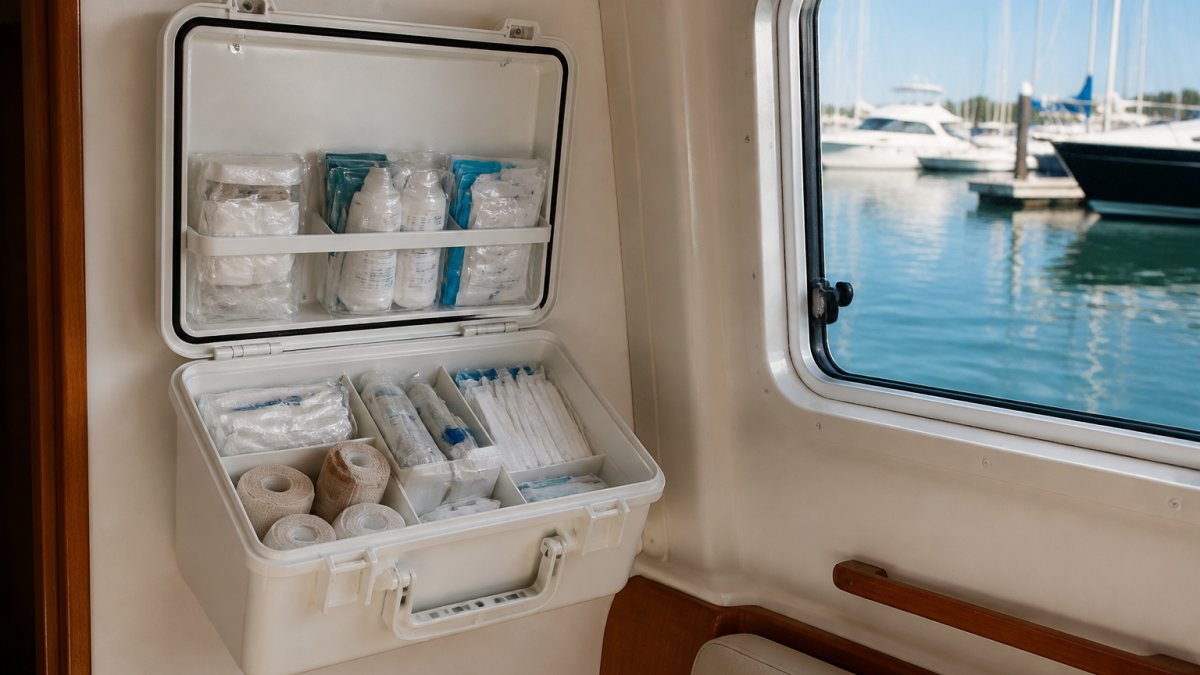
Scale D, E, F and G Compared
The Navigator range covers the common commercial scales, and each is built around a UV-resistant hard case with a water-resistant seal and a wall-mount bracket. Here's how they line up on price:
Kit |
Scale |
Price |
Best For |
|---|---|---|---|
G |
$282.35 |
Enclosed and inshore waters |
|
F |
$339.99 |
Charter craft and workboats |
|
D |
$379.99 |
Commercial fishing and ferries |
|
E |
$379.99 |
Passenger vessels and larger private boats |
All four share the same 42.8 x 30.4 x 14.6 cm case footprint, so the choice comes down to scale, not storage space.

AED for Boats: Does Your Vessel Need One?
An AED for boats is not a blanket legal requirement for every recreational vessel, but it is increasingly expected on commercial craft and larger private boats carrying passengers. Sudden cardiac arrest response time matters most where help is far away.
For any vessel operating with crew or paying passengers, carrying a portable defibrillator is a reasonable step beyond the minimum. We stock portable AEDs and accessories for exactly this use.
NAVIGATOR Scale E Marine First Aid Kit 42.8 x 30.4 x 14.6cm →
Building a Boat Safety Gear Bundle for Family Trips
A family bundle should cover the people on board first, then the boat, then the trip. The mistake most families make is buying a fixed list rather than matching the kit to how the boat is actually used. A runabout doing short hops in enclosed waters needs a very different bundle from a trailer boat heading offshore with four adults and two children.
Match the Bundle to the Trip, Not the Brochure
Work through four questions before you buy anything:
- How far from shore do you go? Carriage requirements scale with distance offshore. A boat that stays in sheltered waterways carries less than one heading beyond the partially smooth waters boundary.
- How many people, and what ages? Life jackets must be correctly sized and fitted to each person, including children. Buy for the maximum number you will ever carry, not the usual number.
- How long are you out? A half-day trip needs a smaller first aid kit and less water than a full day or an overnight. Trip length also affects how much you rely on communication gear.
- What is the vessel? A small open boat has different stowage, fire risk and anchoring needs from a cabin cruiser or a commercial charter.
Answer those four and the bundle largely writes itself.
A Practical Family Bundle by Layer
Layer 1, People. Correctly sized life jackets for every person on board, checked for wear and buoyancy.
Layer 2, Boat. Fire extinguisher, checked and in date. Flares and visual distress signals within their expiry window.
Layer 3, Trip. A way to call for help that works where you are going.
Families often overbuy gadgets and underbuy the basics. A well-fitted jacket and a current kit beat a cabin full of accessories every time.
Where Families Overspend
The common pattern is buying a large commercial-scale first aid kit for a private boat, or a bundle of accessories that duplicates what is already aboard. Check what you already carry before you add. A Scale D or E kit on a family runabout is more capability than the vessel class requires, and the money is better spent on correctly fitted jackets for growing children.
Inspection, Servicing and Expiry Dates: Keeping Gear Current
Gear that isn't checked isn't gear, it's decoration. Flares expire, extinguishers need servicing, and first aid consumables go out of date quietly in a locker.
Build a simple routine:
- Check life jacket fit, straps and buoyancy every trip
- Inspect fire extinguisher gauge and service tag monthly
- Note flare expiry dates and replace before they lapse
For first aid, refills keep an existing case in service without buying a whole new kit. The NAVIGATOR Scale E Marine First Aid Kit Refill at $270.70 restores a Scale E case so it stays compliant between full replacements.
Frequently Asked Questions
Where can I buy marine safety gear on the Gold Coast?
You can buy marine safety gear from a specialist first aid and safety retailer with local stock, which means you can check availability, collect the same day or arrange delivery. Buying locally also lets you confirm the kit matches your vessel class before you pay. PFA Shop stocks the NAVIGATOR range of NSCV-aligned marine first aid kits, from the Scale G at $282.35 up to the Scale D and Scale E at $379.99, so you can match the kit to your boat rather than guessing online.
What safety equipment is required on a boat in Queensland?
Queensland rules require life jackets for everyone on board, a fire extinguisher where applicable, visual distress signals such as flares in certain waters, an anchor and rope, and a first aid kit. Commercial vessels must also meet National Standard for Commercial Vessels (NSCV) requirements for their class. Check the current Maritime Safety Queensland guidance for your vessel type and the waters you operate in, because requirements change with distance from shore and vessel size.
What should a marine first aid kit contain?
A marine first aid kit should carry wound dressings, bandages, tapes, antiseptic, swabs, eye pads, scissors and gloves, all packed so you can find items fast in rough conditions. Marine kits also need a case that resists UV, spray and humidity. The NAVIGATOR Scale D and Scale E kits include dressings, bandages, tapes, swabs, antiseptics and instruments in a UV-resistant hard case with a water-resistant seal and wall-mount bracket, sized at 42.8 x 30.4 x 14.6 cm.
Do boats need an AED?
Recreational vessels are not generally required to carry an AED, but commercial operators and vessels carrying passengers should assess the risk and check their safety management plan. An AED for boats makes sense on larger craft, charter operations and anywhere help is far away. If you fit one, store it dry, check the pads and battery on a schedule, and make sure someone on board knows where it is and how to use it.
How often should marine first aid supplies be checked?
Check your marine first aid kit before every trip and do a full audit at least every three months, replacing anything used, expired or damaged. Salty air and humidity degrade packaging faster than indoor storage, so inspect seals and sterile wraps too. Buying a refill set, such as the NAVIGATOR Scale E Marine First Aid Kit Refill at $270.70, lets you restore an existing case without buying a whole new kit, which keeps costs down across a busy season.
Getting the kit right is only half the job. The other half is keeping it current, matched to your vessel and ready before the next trip. At PFA Shop, we supply marine first aid kits built to NSCV scales, portable AEDs and accessories, and refills that keep your existing case compliant without a full replacement. Browse our marine range or get in touch and we'll help you match the right scale to your vessel before you head out.
