
Safety Equipment for Beach Events: 2026 Checklist
Table of Contents
- Safety Equipment for Beach Events: What Organisers Must Get Right
- Start With a Beach Event Risk Assessment
- The Beach Event Safety Checklist: Equipment by Category
- Water Safety Equipment and Water-Rescue Readiness
- Building an Event First Aid Kit for Sand, Salt and Sun
- AED for Events: Placement, Waterproofing and Readiness
- Emergency, Evacuation and Communication Planning
- Inspection, Maintenance and Compliance Records
- Frequently Asked Questions
Last Updated: October 14, 2026
Safety Equipment for Beach Events: What Organisers Must Get Right
Safety equipment for beach events is the gear, signage, first aid supplies and rescue tools an organiser must have on site to prevent injury and respond to emergencies on sand and in the water.

The biggest mistake is treating a beach event like a park event with a nicer view. Tides move, weather turns and ambulance access is slow, your equipment list must reflect that.
Below: how to assess risk, what to buy, and how to stay compliant.
Safe Work Australia's hazard identification guidance
Start With a Beach Event Risk Assessment
A beach event risk assessment is a written review of every hazard your venue creates before anyone sets foot on the sand. It drives every equipment decision afterwards. Most organisers do this backwards, buying gear first, then writing a plan to justify it. Do it the other way around.
Hazards Unique to a Beach Venue
Beaches add hazards you won't find at an oval or hall:
- Tides and currents that cut off areas mid-event
- Soft sand that slows stretchers, wheelchairs and ambulances
- Heat and glare with almost no natural shade
Map each hazard to a control. A rip current needs a rescue plan and a flotation device, not just a warning sign.
Matching Equipment to Event Size and Activity
A 50-person beach yoga class needs different kit from a 5,000-person surf carnival. Scale equipment to crowd size, activity risk and duration.
Event Size |
Key Equipment Priorities |
Typical Setup |
|---|---|---|
Under 100 people |
First aid kit, signage, hydration, one AED |
1 first aid station |
100-500 people |
Add barriers, shade, second AED, radio comms |
2 stations, 2 marshals |
500-2,000 people |
Add water rescue gear, security, evacuation plan |
3+ stations, lifeguard liaison |
2,000+ people |
Full incident command, dedicated medical post, multiple AEDs |
Professional medical team |
The Beach Event Safety Checklist: Equipment by Category
Use this beach event safety checklist as a starting point, then adapt it to your risk assessment.

Signage, Barriers and Crowd Control
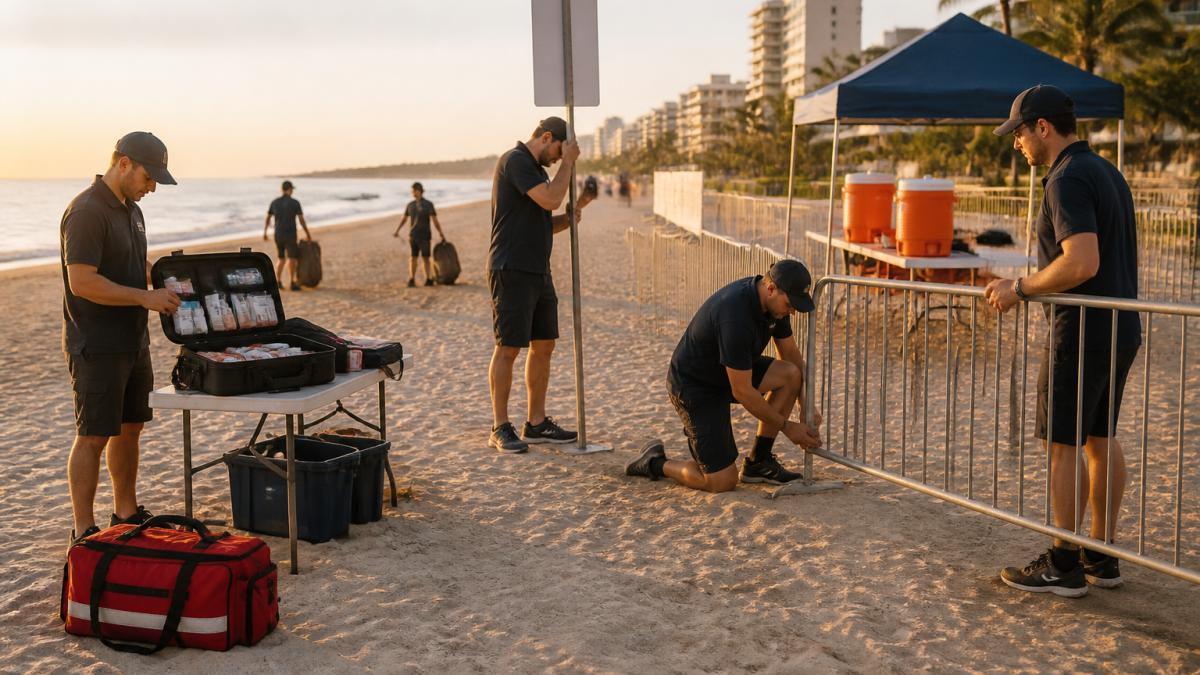
Crowd control keeps people away from water edges, vehicle routes and staging areas.
- Safety signage on weighted or sand-screwed posts
- Temporary fencing and crowd control barriers
- Bunting and rope lines for defined walkways
Wind is the enemy: standard signage blows flat, so use weighted bases or screw-in anchors.
Hydration, Shade and Heat Management
Heat illness is the most common preventable incident at beach events.
- Water station with refill points and cups
- Shade structures and marquees rated for coastal wind
- Electrolyte supplies for long events
Water Safety Equipment and Water-Rescue Readiness
Water safety equipment covers every tool used to prevent drowning and respond to incidents in the water. It is not optional for any event where attendees enter or approach the water.
Your water-rescue setup should include:
- Lifejackets and personal flotation devices in a range of sizes, including children's
- Rescue tubes and throw bags at each water access point
- A rescue board or paddlecraft for reaching swimmers fast
Match the gear to the activity. A paddlecraft race needs different rescue coverage from a sandcastle competition.
Surf Life Saving Australia's water safety guidance
Building an Event First Aid Kit for Sand, Salt and Sun
An event first aid kit for a beach venue must handle trauma, heat illness and marine stings, and survive salt air. Standard workplace kits often fall short on all three.
What your beach kit needs beyond the basics:
- Trauma dressings for serious bleeding and lacerations
- Burn gel and dressings for sunburn and hot-surface burns
- Eye irrigation for sand and salt irritation
For marine environments, a purpose-built kit is worth the extra cost. Our NAVIGATOR Scale E Marine First Aid Kit uses a UV-resistant hard case with a water-resistant seal and a wall-mount bracket, and it's configured for commercial and recreational vessels to align with National Standard for Commercial Vessels requirements. For smaller setups, the NAVIGATOR Scale G Marine First Aid Kit covers enclosed and inshore waters with a similar layout.
AED for Events: Placement, Waterproofing and Readiness
An AED for events should be placed within a three-minute round trip of any point where a crowd gathers. Speed matters most in a cardiac arrest.
Placement rules that work:
- One AED per 300-500 attendees as a working guide
- Position at the busiest point, not the quietest
- Keep it out of direct sun and away from the water line
Beach conditions destroy ordinary AED cases. Our Defibtech Fully Automatic Defibrillator AED "Waterproof Bundle" ships in a deluxe Pelican case with a rescue kit, a soft carry bag and a 3D sign, and the unit runs a single-button interface with voice prompts so untrained responders can use it under pressure.

If you already own a defibrillator, the CARDIACT Waterproof Tough AED Case is rated to IP67 and can be fitted with reusable desiccant silica gel to pull moisture out of the case after opening.
Emergency, Evacuation and Communication Planning
Emergency planning covers how you call for help, clear the site and account for people. On a beach all three are harder, because the venue itself changes during the event, a plan written for a park will fail here.
Defibtech Fully Automatic Defibrillator AED "Waterproof Bundle" →
The Five Scenarios You Must Have a Playbook For
Generic emergency plans list equipment. A beach plan lists scenarios and the first three actions for each. Write these before the event and brief every marshal.
1. Missing person (especially a child).
- First action: stop the music and make a single clear PA call with a description and last-seen point.
- Second action: lock the water edge, post marshals along the shoreline in both directions and stop anyone entering the water until the person is found.
- Third action: notify police and, if the person may be in the water, the local surf life saving or marine rescue service immediately, do not wait.
2. Medical emergency on sand.
- First action: send the AED and first aid kit to the patient, not the patient to the kit.
- Second action: mark a clear ambulance access route from the nearest firm ground to the patient, soft sand bogs a stretcher and trolley.
- Third action: assign one person to meet the ambulance at the access point and guide paramedics in. Do not assume they know the site.
3. Lightning and severe weather.
- First action: monitor a live weather feed and lightning detection app for the whole event window.
- Second action: at the first thunder or lightning alert within your safety radius, clear the open beach and move everyone to hard cover, a building or vehicle, not a marquee or tree.
- Third action: hold the all-clear for at least 30 minutes after the last thunder or lightning before restarting.
4. Dangerous surf or a rip current.
- First action: if a swimmer is in trouble, throw a flotation aid before entering the water, untrained rescuers drown.
- Second action: alert the rostered water safety personnel; if there is no water safety team, call 000 and the local surf life saving service.
- Third action: close the water for the rest of the event and reassess before reopening.
5. Moving a crowd away from the shoreline.
- First action: use a single, calm, repeated PA message with a clear direction, "move to the grass area behind the surf club" beats "please evacuate".
- Second action: place marshals at the water's edge as a physical barrier, facing the crowd, not the water.
- Third action: sweep the sand in a line for anyone left behind, especially children and people with limited mobility.
Evacuation Points and Access Routes
Mark evacuation points on firm ground, above the tide line and away from the water. Check the tide chart for your event window, a point dry at 9am can be underwater at 2pm.
Keep at least one ambulance access route marked and clear at all times. On soft sand that usually means matting, boards or compacted sand from the nearest vehicle access to the medical post.
Communication Devices and Distress Signals
Mobile coverage on beaches is patchy, especially in coves and at the base of headlands. Do not rely on a single network.
- Carry at least two independent communication methods, for example, a mobile phone on one network plus a UHF radio or satellite messenger.
- Test coverage at the venue during setup, not on the day.
- For events with vessels or offshore activity, carry an EPIRB or personal locator beacon and know how to activate it.
The Incident Controller
Name one person as incident controller with authority to stop the event, close the water or evacuate without waiting for a committee. In a real incident the delay is almost never the response, it is the decision. Put the controller's name and mobile number on every marshal's briefing sheet.
The test of a beach emergency plan is simple: can a stranger read it and act on it in 60 seconds? If not, rewrite it. Then run one scenario as a tabletop drill with your marshals before the event.
Australian Maritime Safety Authority on distress beacons and EPIRBs
Inspection, Maintenance and Compliance Records
Compliance records prove your equipment was checked, stocked and in date, without them you have no defence if something goes wrong. On a beach they also catch the slow salt, UV and humidity damage that turns a serviceable kit into a failed one unnoticed.
What Beach Conditions Actually Do to Your Kit
- Salt spray and humidity corrode metal clasps, zips, battery contacts and AED terminals, a case that looks fine outside can have green corrosion inside.
- UV exposure makes plastic brittle, fades signage, degrades straps and cracks seals on first aid cases and coolers.
- Heat shortens battery life and degrades medications, burn gels and electrolyte supplies stored in a hot marquee or vehicle.
Pre-Event Inspection Routine
Run this before every event, not just at the start of the season.
- Open every first aid kit and check contents against the inventory, restock anything used at the last event
- Check expiry dates on medications, burn gel, eye irrigation and saline
- Inspect AED status indicator, battery expiry and pad expiry; replace pads after any use or expiry
Post-Event and Seasonal Maintenance
After every event, dry and clean anything wet or sandy before storage. Salt left on gear for a week does more damage than a single day of use.
At least once a season, or more often if the kit is stored near the coast:
- Replace desiccant silica gel in AED cases and sealed storage
- Service AEDs and fire equipment on the manufacturer's schedule
- Replace UV-degraded signage, straps and cases rather than patching them
Record-Keeping That Actually Works
A log only helps if it is quick to complete and easy to produce later. Keep it simple:
- One page per event: date, venue, inspector name, items checked, findings, actions taken
- Photograph the open kit after each restock and store the image with the log, it takes ten seconds and settles any dispute about what was on site
- Keep AED battery and pad expiry dates in a single calendar with reminders a month ahead
Assign one person as equipment custodian for the season. Give them a recurring calendar reminder for the monthly AED check and the seasonal service. The paperwork is the easy part, the hard part is building a routine that survives a busy season.
Compliance and Responsibility
Requirements vary by location, event type and venue. A council-run beach, a national park beach and a private foreshore can each have different permit conditions, and some specify minimum first aid, water safety or communication provisions. Confirm the rules with the local council, venue or land manager, and any relevant state or territory authority before finalising your equipment list.
Frequently Asked Questions
What safety equipment should you have at a beach event?
At minimum, plan for a stocked event first aid kit, an AED for events, water safety equipment such as rescue tubes and throw lines, hydration stations, shade, safety signage, temporary fencing or crowd control barriers, and a communication plan with emergency access routes marked. Equipment quantities should match your crowd size, the activities planned and your beach event risk assessment, since a swim carnival needs more water-rescue gear than a seated concert.
What should go into an event first aid kit for a beach setting?
A beach event first aid kit needs dressings and bandages for cuts, grazes and sprains, burn gel for sun and heat injuries, eye irrigation for sand and salt irritation, gloves, and wound-cleaning supplies. For marine and shoreline use, choose a kit in a hard, water-resistant case, such as the NAVIGATOR Scale G Marine First Aid Kit, which is built around Australian NSCV requirements and suits enclosed and inshore waters. Check stock levels before every event.
When does a beach event need an AED on site?
Any event with a large crowd, older attendees, physical activity or limited ambulance access should have an AED on site. Sudden cardiac arrest survival drops with every minute without defibrillation, so placing an AED within a short walk of the main activity area matters. A waterproof option like the Defibtech Fully Automatic Defibrillator AED Waterproof Bundle ($2,670.00) suits coastal conditions and includes a Pelican case, rescue kit and signage.
How do you keep safety equipment ready in salt, sand and sun?
Use hard cases with water-resistant seals, store gear off the sand and out of direct sun, and inspect everything before and after each event. Rinse and dry metal items exposed to salt spray, check expiry dates on dressings and AED pads, and log every check. A waterproof case such as the CARDIACT Waterproof Tough AED Case ($200.00), rated IP67, protects a defibrillator in humid coastal conditions. Book a maintenance review before your event season starts.
Beach events throw hazards at you that no other venue does, and standard event kit won't cover them. PFA Shop supplies the gear that does: marine-grade first aid kits built for salt and spray, waterproof AED bundles with everything you need in one case, and rugged protective cases for the defibrillator you already own. Get started with PFA Shop and walk onto the sand knowing your equipment is ready before you need it.