
Buy Portable AED for Sports Club: 2026 Buying Guide
Table of Contents
- Quick Comparison: Portable AEDs and Bundles for Clubs
- What to Look For When You Buy Portable AED for Sports Club Use
- Portable and Transportable Defibrillator Options for Clubs
- AED for Schools and Sports Clubs: Packages Built for Shared Facilities
- Total Cost of Ownership: AED Pads and Battery Replacement
- AED Maintenance Checklist for Club Volunteers
- AED Grants for Sports Clubs and Compliance Requirements
- Conclusion
- Frequently Asked Questions
Last Updated: October 7, 2026
Quick Comparison: Portable AEDs and Bundles for Clubs
If you need to buy portable AED for sports club use, the Defibtech Lifeline range and the Elliot POCKET AED cover almost every scenario.
At PFA Shop, we supply both families of device, and neither is "better" in the abstract.
Here is the range side by side, with current pricing.
Device |
Price |
Weight |
Best For |
|---|---|---|---|
Defibtech Lifeline AED (Fully-Auto or Semi-Auto) |
$2,300.00 |
2 kg |
Clubrooms and fixed public access points |
Defibtech Bracket Bundle |
$2,440.00 |
2 kg |
Wall-mounted clubhouse installs |
Defibtech Cabinet Bundle |
$2,615.00 |
2 kg |
Alarmed, signposted public access |
$2,670.00 |
2 kg |
Outdoor and travel use |
|
Elliot POCKET AED |
$1,395.00 |
680 g |
Volunteers carrying it onto the field |
Elliot "Grab and Go" Package |
$1,620.00 |
680 g |
Complete portable kit with case and prep kit |
The most common mistake is buying on price alone, then finding the unit too heavy to carry to the far side of the ground.

What to Look For When You Buy Portable AED for Sports Club Use
Four features decide whether a portable defibrillator works in a real emergency: adult and paediatric modes, pad and battery inclusions, warranty length, and how quickly an untrained volunteer can operate it.
Clubs rarely regret buying a slightly more expensive unit, but they frequently regret buying one that confuses a first-time rescuer.
Adult and Paediatric Use
Most clubs need both adult and child capability, because junior teams train and play at the same venue. Defibtech Lifeline units ship with adult pads pre-connected, with paediatric pads available separately. The Elliot goes further: adult and paediatric mode sit on the same pads, switched with one button, so there is no second set to find in an emergency.

Battery and Electrode-Pad Inclusions
Battery standby life and pad life drive your long-term cost. Defibtech Lifeline units come with a 7-year battery pack in the standard configuration, with a 5-year battery also available, and pads are pre-connected. The Elliot runs on four standard CR123A batteries with roughly a 3-year life, replacement costs around $20 to $40 with no proprietary charger, and its pads carry a 5-year life.
Warranty Coverage and Ease of Use
Warranty length separates the two families clearly: the Elliot carries a 6-year warranty. Both are backed by daily self-checks, so a fault is usually visible before match day rather than during it.
Ease of use is where the Elliot was designed for a different buyer: pull the handle and it begins voice prompts, visual guidance, and a CPR metronome.
Portable and Transportable Defibrillator Options for Clubs
Portability splits into two jobs: a unit that lives on a wall but can be grabbed, and one that travels in a bag every week.
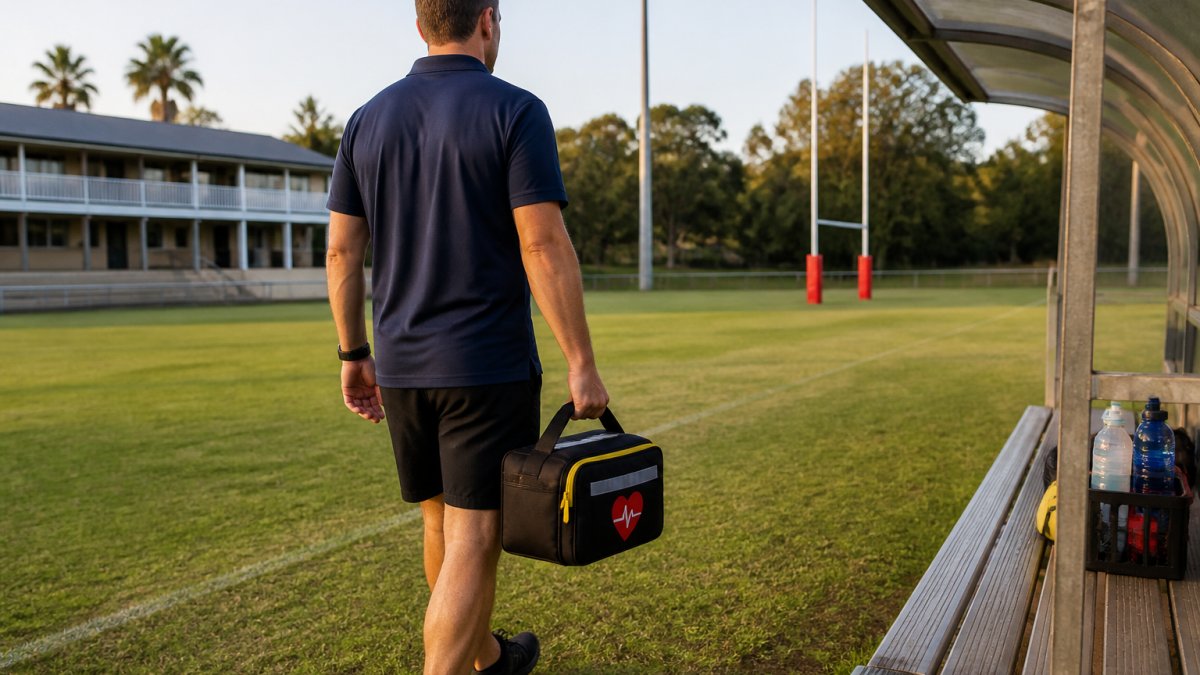
The Defibtech Bracket Bundle at $2,440.00 suits the first job: wall bracket, rescue kit, soft carry bag, and 3D sign, so the unit is fixed but detachable. The Cabinet Bundle at $2,615.00 adds an alarmed wall cabinet for a clubhouse foyer or shared facility.

Placement and Portability Around the Ground
Placement should follow response time, not convenience. A defibrillator that takes four minutes to reach the far touchline arrives too late. We suggest clubs plan two locations: a fixed point at the clubhouse for public access, and a carry point that travels with the trainer or team manager. If your venue hosts multiple fields, the carry point does the real work.
AED for Schools and Sports Clubs: Packages Built for Shared Facilities
Shared facilities need a package, not a bare unit. Schools and clubs that share grounds, changerooms, and canteens need signage, a rescue kit, and a carry option in one purchase. The Defibtech bundles are built around that idea: the Bracket Bundle adds a wall bracket, rescue kit, soft carry bag, and 3D sign, while the Cabinet Bundle swaps the bracket for an alarmed wall cabinet.
Total Cost of Ownership: AED Pads and Battery Replacement
Purchase price is roughly half the story. Over a ten-year life, pads and batteries often cost as much as the unit itself.
Here is how the two families compare on running costs.
Cost Item |
Elliot POCKET AED |
|
|---|---|---|
Purchase price |
From $2,300.00 |
From $1,395.00 |
Battery standby life |
7 years |
About 3 years |
Battery replacement cost |
Specialist pack |
About $20 to $40 |
Pad life |
5 years |
|
Warranty |
6 years |
The Defibtech's long battery and 8-year warranty mean fewer replacement cycles, suiting clubs that want to set and forget. The Elliot's cheap, standard batteries and 5-year pads mean lower consumable costs but more frequent battery changes.
AED Maintenance Checklist for Club Volunteers
A monthly check takes under five minutes and catches almost every failure mode. The difference between a club that is ready and one that is not is rarely the device. It is whether a named person owns the check and whether the record survives the season.
Assign the role, not the task
"The committee" does not do maintenance. A named volunteer does. Most clubs run best with:
- A primary AED officer who performs the monthly check and holds the spare pads and battery.
- A backup who covers holidays, finals, and the off-season.
- A committee contact who receives the record and signs off on replacements.
Record the names and contact details in the club's safety file and inside the cabinet door.
Defibtech Fully Automatic Defibrillator AED "Waterproof Bundle" →
Monthly check
- Confirm the status indicator shows ready, with no warning light or audible alert
- Check the pads are sealed, in date, and still connected
- Check the battery expiry date against the replacement schedule
Seasonal and event-specific checks
- Pre-season. Replace any pads or battery expiring during the season. Test the unit, confirm the carry bag, and brief new volunteers.
- Before finals and tournaments. Re-check the unit, confirm it travels to away venues, and confirm the trainer or team manager knows where it is.
- After extreme heat or cold. Batteries and pads degrade faster outside their storage range. Check the unit if it has been left in a vehicle or shed.
What the electronics cannot see
Most modern units run daily self-checks, which covers the electronics. The manual check covers what they cannot see: missing pads, a borrowed carry bag, a locked cabinet with a lost key, a unit left in a hot car, or a battery swapped for a cheaper substitute.
Post-incident steps
After any use, even a false alarm:
- Make the scene safe and hand over to ambulance officers if present.
- Do not switch the unit off until paramedics advise.
- Download or note the event data if the device supports it.
- Replace pads and battery.
- Record the incident in the club's safety file.
- Offer support to the responder and debrief the response.
- Restock the rescue kit and return the unit to its place.
Records that matter
Keep a simple log with the date, the checker's name, the result, and any action taken. If a regulator, insurer, or funder ever asks, that log is the evidence the club took its duty seriously, and it makes grant acquittals and insurance claims far easier.
AED Grants for Sports Clubs and Compliance Requirements
Most clubs do not pay full retail. Funding exists at three levels, and the strongest applications are built before you request a quote, not after.
Where the money usually comes from
- State and territory sport and recreation agencies. These run the main community sport grant rounds, typically funding equipment, first aid, and safety items. They usually require the club to be incorporated, have an ABN, and be affiliated with a recognised state sporting body.
- Local councils. Many run community grants or small equipment subsidies. These are often smaller with tighter closing dates, so they suit a top-up rather than the whole purchase.
- National sporting organisations and peak bodies. Some sports run their own safety-equipment programs or partner with suppliers on subsidised bundles.
Eligibility, amounts, and closing dates change between rounds and vary by jurisdiction. Always read the current guidelines on the relevant government sport portal before you draft anything.
What a strong application actually contains
Committees that get funded tend to submit the same four things:
- A documented risk assessment. Identify the venue, the number of participants and spectators, the distance to the nearest ambulance response, and the sports with known cardiac risk.
- A placement and portability plan. State where the unit lives, who carries it to the far field, and how it is accessed after hours.
- A maintenance and training commitment. Name the volunteer responsible, the monthly check, and the training the club will run.
- A quote and a total cost of ownership figure. Include the unit, a spare set of pads, and the first battery replacement so the grant covers the system, not just the box.
A common pattern: clubs that list only a purchase price are asked to resubmit, while clubs that show the full ten-year cost are approved first time.
Compliance: what actually applies to a club
Work health and safety duties require a person conducting a business or undertaking to provide first aid equipment and access to facilities for administering first aid. For a sporting club, that generally means:
- A first aid risk assessment for each venue and activity
- Accessible first aid equipment, including an AED where risk warrants it
- Trained first aiders and a documented emergency response plan
The specific requirements depend on your jurisdiction, incorporated status, whether you employ staff, and your risk profile. Safe Work Australia publishes national guidance that state and territory regulators apply. Confirm your obligations with your own regulator rather than relying on a supplier's summary.
Registration and procurement checks
Before a committee or school council approves spending, confirm:
- The device is listed on the TGA's Australian Register of Therapeutic Goods (ARTG)
- The supplier provides a tax invoice with an ABN and GST
- The warranty terms are in writing, including what voids them
A practical sequence
- Run the risk assessment and record response times.
- Choose the device and bundle against your placement plan.
- Get a written quote including consumables and the first replacement cycle.
- Check the current grant round and eligibility.
- Submit the application with the risk assessment, placement plan, maintenance commitment, and quote attached.
- Once approved, purchase, register the warranty, and schedule the first monthly check.
- Record the installation, training, and maintenance in the club's safety file.
That sequence answers the two questions every funder and committee asks: why this device, and who keeps it ready.
Conclusion
The hardest part of buying a portable AED for a sports club is not the purchase.
We supply the Defibtech Lifeline range for clubhouses and public access points, and the Elliot POCKET AED for volunteers who need to carry it.
Get started with PFA Shop and build a defibrillator setup your volunteers can actually use on match day.
Frequently Asked Questions
Can I buy a portable AED for a sports club without a prescription?
Yes. In Australia, portable AEDs are listed on the TGA's Australian Register of Therapeutic Goods and can be purchased without a prescription by clubs, schools and individuals. Look for the ARTG number on the listing, such as the Elliot POCKET AED (ARTG #387771). Defibtech Lifeline models are also available for direct purchase. Buy from a supplier that includes the battery, adult pads and a carry case in the price so the unit is rescue-ready the day it arrives.
What features should a sports club look for in a portable AED?
Prioritise weight, weather rating and pad flexibility. A unit around 2 kg or less is realistic to carry across a ground. Check the IP rating: IP54 handles dust and splashes, while IP66 (as on the Elliot POCKET AED) suits outdoor and coastal venues. Confirm the unit supports both adult and paediatric use, either with separate pads or a one-button switching mode. Battery standby life of 5 to 7 years and a 6-year warranty on the Elliot POCKET AED reduce long-term costs.
How often do AED pads and batteries need replacing?
Electrode pads for the Elliot POCKET AED have a 5-year life. Batteries vary: Defibtech Lifeline packs offer a 7-year standby life and deliver up to 300 shocks or 16 hours of continuous operation, while the Elliot POCKET AED uses four standard CR123A batteries with a 3-year life and a replacement cost of about $20 to $40. Check expiry dates at every monthly inspection.
How can a sports club get funding for a portable AED?
Several pathways exist. Federal and state grant programs periodically fund defibrillators for community sporting organisations, and local councils often run their own equipment grants. Some clubs raise funds through canteen profits, sponsorship or a members' appeal. When applying, include the total cost of ownership, not just the purchase price: pads, batteries and a cabinet all count. Keep the receipt and ARTG listing on file as evidence of a compliant device.
What is the three-minute rule for AED use?
The three-minute rule refers to defibrillation timing: survival rates drop by roughly 10% for every minute that passes without a shock after sudden cardiac arrest. Clubs should place a portable AED so it can reach any point on the field, court or training area within three minutes. For a large oval, that usually means a central location or a second unit, plus a clearly signed cabinet and a response plan that names who retrieves the device.