
Choosing the Best First Aid Kit for a Factory Floor
Last Updated: November 22, 2026
Quick Summary
The best first aid kit for a factory is a high-risk workplace kit with more dressings, burn and eye supplies, and a tougher case than an office kit. Match the case style to your conditions, the contents to your hazards, and the quantity to your worker numbers and distance from medical help.
- A factory kit adds depth in wound, burn and eye care and usually needs a hard case that survives knocks.
- Size stock to worker numbers, shift pattern and distance to the nearest hospital, not just item presence.
- The Commander 6 Series Metal Tough costs $332.15 and suits fixed wall stations in dusty workshops.
- The Modulator Waterproof Tough costs $390.00 and has six colour-coded modules removable for carrying to the casualty.
- Use the quarterly inspection checklist and assign a named owner to each kit so it stays audit-ready.
Table of Contents
- What Separates a Factory Kit From a Standard Workplace Kit
- Factory First Aid Kit Contents You Should Expect
- The High-Risk Workplace First Aid Kit Standard Explained
- Comparing Factory-Ready Kits: Metal, Plastic, Softpack and Modular
- How Often to Inspect Workplace First Aid Kits
- A Workplace First Aid Kit Inspection Checklist for Factory Supervisors
- Matching Kit Quantity and Placement to Your Factory Layout
- Ordering the Right Kit for Your Factory Floor
- Frequently Asked Questions
What Separates a Factory Kit From a Standard Workplace Kit
A factory first aid kit is a workplace kit built for higher injury risk, larger worker numbers and harsher conditions than a standard office kit.
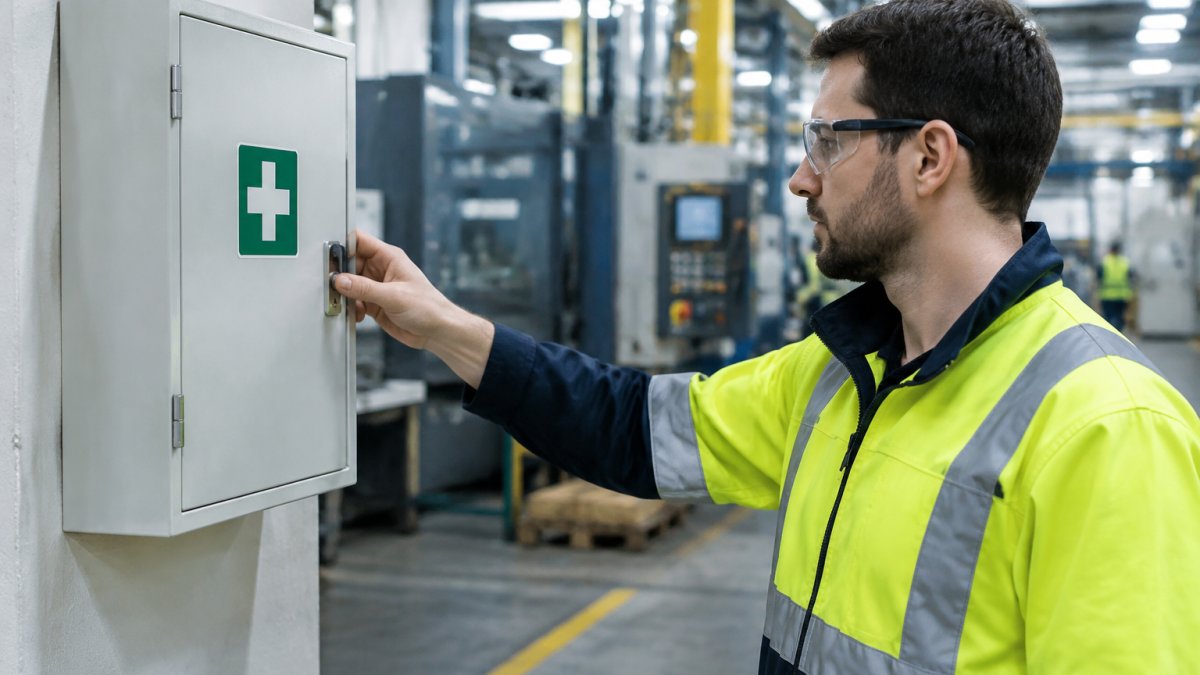
At PFA Shop, buyers ask for capacity, protection from dust and knocks, and contents matched to real hazards like cuts, burns, sprains and chemical splashes.
A standard workplace kit covers the basics. A factory kit adds depth in wound, burn and eye care, and usually needs a hard case that survives knocks.
Factory First Aid Kit Contents You Should Expect
Factory first aid kit contents should be reverse-engineered from the injuries your floor actually produces, not copied from an office kit list.
Here is how factory hazards map to the contents that matter:
- Machinery lacerations and crush injuries: sterile gauze swabs and pads in several sizes, non-adherent (non-stick) dressings, adhesive dressing strips, combine dressings and pads for heavier bleeding, crepe and elastic bandages, triangular bandages, adhesive tape, and trauma shears. Crush and amputation risks also justify a tourniquet and a haemostatic dressing where your risk assessment identifies severe bleeding as credible.
- Thermal burns from hot surfaces, steam and molten material: burn dressings, burn gel packs and gel-soaked burn sheets, plus cling film as a recognised provisional burn cover. Stock enough to cover a hand, a forearm and a larger area, because a single small burn dressing will not cover a splash across the chest.
- Chemical splashes and exposure: eye wash pods or bottles, eye pads, and irrigation supplies. A first aid kit is not a substitute for a plumbed emergency shower and eyewash station where chemicals are stored or decanted, the kit covers the walk to the station and the immediate response, not the full decontamination.
- Eye injuries from dust, grit, swarf and sparks: eye pads, eye wash and a small mirror or guidance card so a worker can irrigate without help. Safety glasses reduce but do not eliminate these injuries.
- Sprains, strains and manual-handling injuries: crepe bandages, elastic supports, triangular bandages for slings, and instant cold packs.
What most guides miss is quantity. A kit with the right items but too few runs dry after the first busy week, and a 40-worker shift will exhaust a small kit on a single serious laceration.
Watch out: a kit can list every category above and still be wrong for your floor if quantities are sized for an office.
The High-Risk Workplace First Aid Kit Standard Explained
A high-risk workplace first aid kit is a kit sized and stocked for environments where serious injury is more likely, such as manufacturing, construction and workshops.
The code ties kit requirements to risk level, worker numbers and distance from medical help.
Watch out: buying a kit labelled "workplace" without checking it against your risk assessment is the most common compliance gap we see.
Comparing Factory-Ready Kits: Metal, Plastic, Softpack and Modular
Four case styles cover most factory needs: metal cabinets, rugged plastic, softpack and modular. The right pick depends on where the kit lives and how much protection the contents need.
| Kit | Case Style | Price (AUD) | Best For | Watch Point |
|---|---|---|---|---|
| Commander 6 Series Metal Tough | Metal cabinet | $332.15 | Fixed wall stations in dusty workshops | Needs wall space |
| Commander 6 Series Plastic Rugged | Rugged plastic | $269.99 | Benchtop or shelf in damp areas | Less impact protection than metal |
| Commander 6 Series Softpack Versatile | Reinforced softpack | $229.99 | Mobile crews and vehicles | Softer shell, less crush protection |
| Modulator Waterproof Tough | Waterproof plastic | $390.00 | Wet, harsh or outdoor areas | Higher upfront cost |
Price (AUD)
For a deeper look at construction trade-offs, read our comparison of metal vs softpack first aid kits for industrial use.
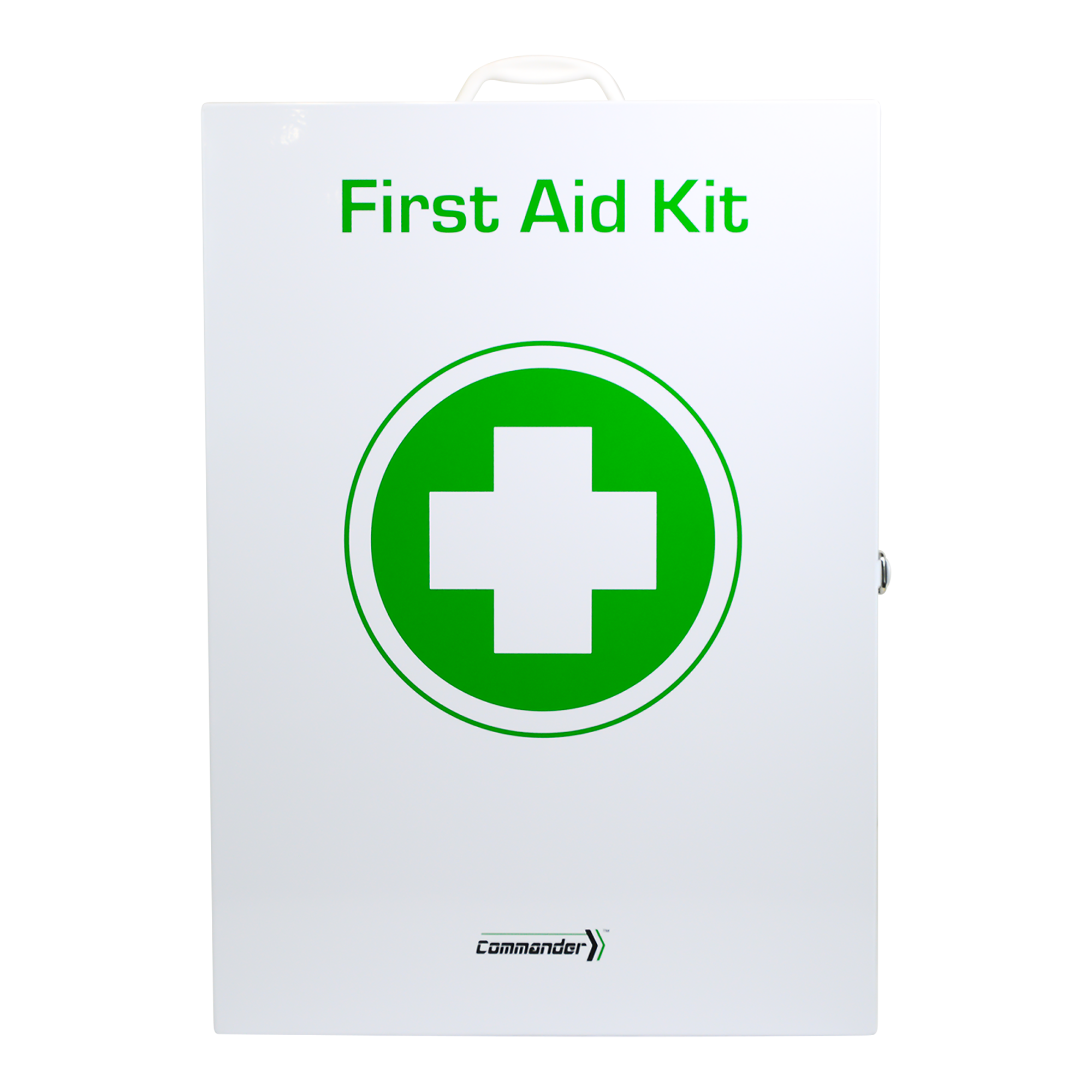
Commander 6 Series Metal Tough First Aid Kit
The metal cabinet suits a fixed factory first aid station. Its metal housing protects contents from dust and knocks.
It is compatible with the Surefill instant refill program, whose refill pouches have a centre-slit pocket for quick access to products.
Best for: busy manufacturing floors that need a durable, high-capacity wall station. Skip if: you need a kit that travels with a crew.
View the Commander 6 Series Metal Tough First Aid Kit
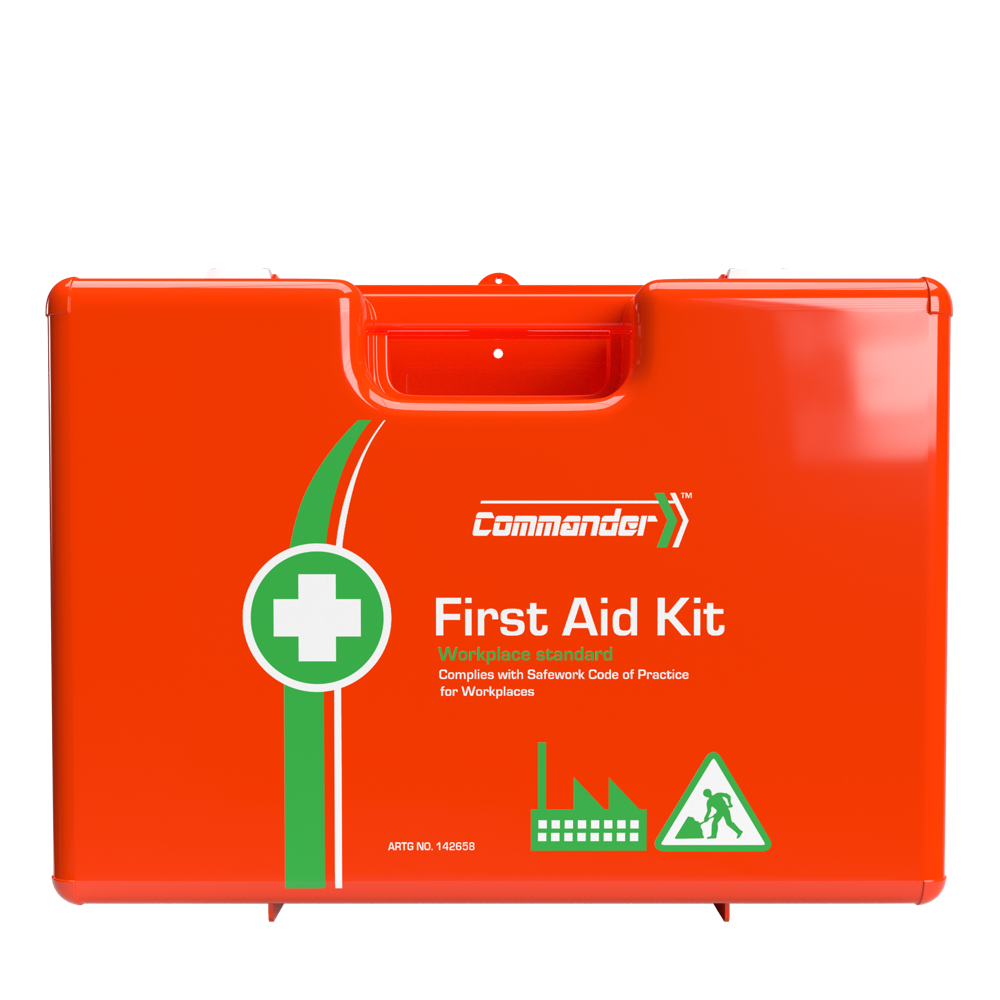
Commander 6 Series Plastic Rugged First Aid Kit
The hard plastic case resists dust and splashes, and the compact footprint sits neatly on a shelf or benchtop.
Internal sections group wound care, burns care, eye care and bandaging, simplifying restocking and keeping the kit aligned with workplace standards and internal safety policies.
Best for: workshops and warehouses that want a hard case without metal. Skip if: the kit will take heavy impact in a high-traffic bay.
Check the Commander 6 Series Plastic Rugged First Aid Kit
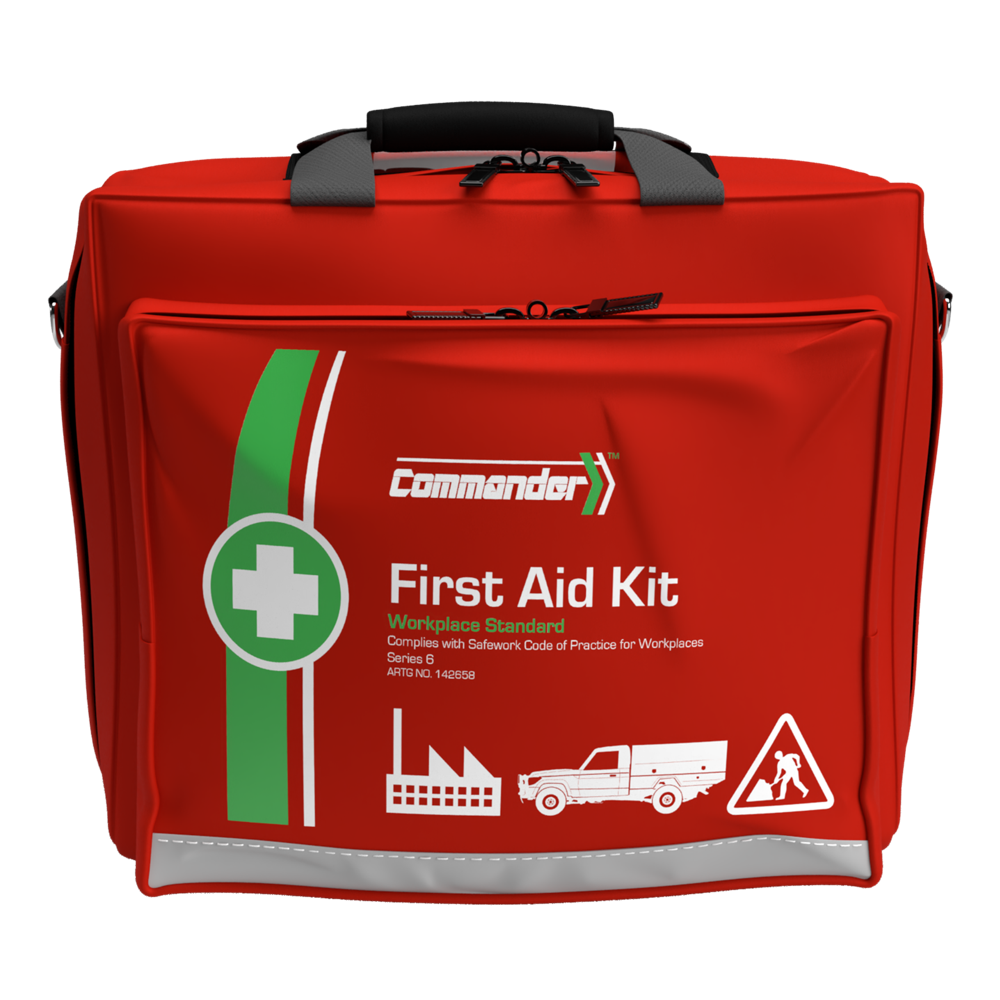
Commander 6 Series Softpack Versatile First Aid Kit
Softpack is the portable choice. The reinforced high-visibility red fabric bag has a wide opening, strong zips and an integrated shoulder strap for grab-and-go use between treatment areas, vehicles and remote job sites.
It is built for everyday readiness with a softer shell than the rigid case options.
Best for: mobile crews, service vehicles and multi-area sites. Skip if: the kit stays fixed in a dusty, high-impact zone.
See the Commander 6 Series Softpack Versatile First Aid Kit
Modulator Waterproof Tough First Aid Kit
The Modulator is the most structured option.
Each module can be removed and carried to the casualty, cutting movement back and forth to the main kit. The waterproof shell is designed for protection from moisture, dust and impact.
Best for: factories with wet processes, outdoor yards or a need for fast injury-specific response. Skip if: you want the lowest upfront cost.
View the Modulator Waterproof Tough First Aid Kit
How Often to Inspect Workplace First Aid Kits
Inspection frequency should be set against your own risk assessment, with regular checks of contents and expiry dates.
A kit is only useful if it is complete.
Safe Work Australia's first aid code guidance supports routine checking as part of your duty of care.
A frequency alone is not a system. The factories that stay audit-ready tend to run four things together:
- A named owner per kit. Assign each station to a supervisor or safety officer by name, not to "the safety team". A kit with no owner is the kit that runs out.
- A dated inspection record kept with the kit. Record the date, the checker, what was used, what was replaced and what is on order. This is the evidence a regulator or auditor will ask for, and it also shows whether a kit is being used faster than expected.
- A refill mechanism that matches the case. Pouch-based refill programs such as Surefill are available for Commander 6 Series kits.
- A trigger to resize. If inspections show the same items running out between checks, the kit is undersized for the floor, not badly managed. Use the inspection record to justify adding a second station or moving to a larger capacity kit.
Expiry management is where most sites slip.
Watch out: a kit that passes a visual check can still fail an audit because contents are in date but quantities are too low for the current headcount.
A Workplace First Aid Kit Inspection Checklist for Factory Supervisors
Use this workplace first aid kit inspection checklist each quarter. It takes minutes and keeps the kit audit-ready.
- Confirm the kit is in its marked location and clearly visible
- Check the case, latches and handle for damage
- Verify all required contents are present and in the right sections
- Check expiry dates on dressings, wipes and antiseptic products
- Replace used or missing items immediately
- Confirm gloves and hygiene supplies are stocked
Matching Kit Quantity and Placement to Your Factory Layout
Kit quantity and placement should follow your floor plan, not just your headcount. Put a kit within easy reach of every high-risk zone so a worker can get to one without crossing the whole factory.
A practical approach:
- Place a main station near the busiest production area
- Add a second kit near hot processes, chemicals or cutting equipment
- Keep a softpack kit with any mobile crew or vehicle
- Mount fixed kits at eye level on a clear, signed wall
- Keep every station clear of stacked stock and machinery
Many factories find two well-placed kits beat one large kit in a central office. Distance matters in an emergency, and seconds count.
Ordering the Right Kit for Your Factory Floor
Choosing the best first aid kit for a factory comes down to four things: hazards, worker numbers, floor layout and the conditions the kit will face. Match the case style to the environment, the contents to the risks, and the quantity to the people on site.
At PFA Shop, we stock a range of workplace first aid kits in metal, plastic, softpack and modular options, with the Surefill refill program available for Commander 6 Series kits. Our range covers metal, plastic, softpack and modular options so you can match the kit to the job.
Start with a quick walk of your floor and note where injuries are most likely. Then match a kit to each zone, set a quarterly inspection routine, and keep refills on hand so the kit is always complete.
Frequently Asked Questions
What should a first aid kit contain in a factory?
A factory first aid kit needs more than adhesive strips. Look for sterile gauze pads, non-stick dressings, crepe and triangular bandages, adhesive tape, eye pads and eye wash, burn treatment supplies, antiseptic wipes and cream, disposable gloves and hygiene supplies. Because factories carry cut, crush, burn and eye hazards, the kit should also cover trauma dressings and splinter removal. The Commander 6 Series and Modulator ranges group these by injury type so first aiders find the right item under pressure.
How often should workplace first aid kits be inspected?
Check your kit after every use, and run a full audit at least quarterly. High-risk sites with chemicals, hot work or heavy machinery benefit from monthly checks. Confirm that dressings are sealed, sterile items are in date, eye wash is full and nothing has been taken without replacement. Record each inspection with a date and initials so you can show a consistent maintenance record during a safety review.
What is the difference between a standard and high-risk workplace first aid kit?
A standard kit covers everyday cuts, grazes and sprains for low-risk settings such as offices. A high-risk workplace first aid kit adds supplies for serious bleeding, burns, eye injuries and trauma, and carries larger quantities because more workers face those hazards. Factories with sharp tooling, hot surfaces or chemical exposure should treat themselves as high risk and stock accordingly, then confirm the contents against the current Safe Work Australia code of practice.
How many first aid kits does a factory need?
There is no single number. Work through the layout: place a kit within easy reach of every work zone, typically no more than a short walk from any workstation, and add kits for separate buildings, remote plant rooms and vehicle bays. Factor in shift numbers, visitors and contractors. A large factory often needs several wall-mounted stations plus a portable softpack for field crews, with one nominated person responsible for restocking each one.
Where should first aid kits be located in a factory?
Mount kits in visible, clearly signed positions near the highest-risk areas: workshops, cutting stations, welding bays and chemical stores. Keep them off the floor, away from direct heat and out of locked rooms that slow access during a shift. Every worker should know the nearest kit without checking a map. Add a portable kit for maintenance crews working away from fixed stations, and check placement again whenever you reconfigure the floor.
