
7 Best AED Brands for Manufacturing Sites
Last Updated: October 28, 2026
Quick Summary
The best AED brands for manufacturing sites include Mindray, LIFEPAK and Defibtech, based on protection ratings, guidance features and battery life. Compare AED brands by matching each model's IP rating, prompts and pad and battery lifespan to your site's dust, noise and vibration conditions.
- The Mindray (Semi-Auto Currently out of stock, more on the way) C1A is the lowest-cost pick at $1,900 with IP55 protection and 360J capability.
- The LIFEPAK CR2 adds ClearVoice, which adjusts volume to background noise, and cprINSIGHT analysis.
- The Defibtech Lifeline offers a seven-year battery standby life and up to 300 shocks.
- Time the worst-case AED retrieval route at shift change and add units where the walk fails.
- The LIFEPAK CR2 cprINSIGHT Wi-Fi lists a four-year standby battery life and four-year electrode expiry.
Table of Contents
- Quick Comparison: Best AED Brands for Manufacturing Sites
- How to Choose an AED for a Manufacturing Facility
- Mindray C1A and C2: The Value Pick for Factory Floors
- LIFEPAK CR2: The Rugged AED for Harsh Environments
- Defibtech Lifeline: Long Battery Life and Low Upkeep
- Workplace AED Placement Across Large and Multi-Building Sites
- AED Battery and Pad Replacement: What It Really Costs
- Your AED Maintenance Checklist for Shift After Shift
- Frequently Asked Questions
Quick Comparison: Best AED Brands for Manufacturing Sites
Choosing among AEDs for manufacturing sites involves considering the device's features, maintenance requirements and cost. The shortlist below includes products available from PFA Shop.
Quick Picks:
- Best value: Mindray C1A, IP55 rated, 360J, $1,900
- Best for noisy, dusty plants: LIFEPAK CR2, ClearVoice and cprINSIGHT
- Defibtech Lifeline: 7-year battery standby
- Mindray C2: wireless and 4G connectivity options
Model |
Price (AUD) |
Protection |
Standout |
|---|---|---|---|
Mindray C1A |
$1,900 |
IP55 |
Lowest cost, 360J |
Mindray C2 |
$2,450 |
IP55 |
7" colour display |
LIFEPAK CR2 Essential |
$2,999.99 |
IP55 |
ClearVoice, cprCOACH |
LIFEPAK CR2 cprINSIGHT Wi-Fi |
$4,145 |
IP55 |
Remote monitoring |
Defibtech Lifeline |
$2,300 |
IP54 |
7-year battery |
How to Choose an AED for a Manufacturing Facility
When choosing an AED for a manufacturing facility, consider the site environment and who may need to use the device. Dust, noise and vibration are among the conditions to consider.
Start with the environment, not the brand
Work through the conditions the device will actually live in before you compare models:
- Airborne dust and particulate. Consider whether airborne dust is present in the proposed location and check the device's listed protection rating.
- Moisture and wash-down. Consider moisture exposure when choosing a location for an AED.
- Temperature extremes. Consider the temperature conditions at the proposed location.
- Vibration and impact. Consider potential vibration and impact at the proposed location.
- Noise. Consider background noise when assessing whether voice prompts will be useful at the proposed location.
- PPE and glove use. Consider the conditions in which a rescuer may need to use the device.
Then match the device to your facility risk profile
Consider the conditions in different parts of a site when deciding where AEDs may be needed:
- Production floors and fabrication areas. Consider noise, dust and vibration when assessing the location.
- Warehouses and distribution centres. Consider floor area, traffic and travel distances when planning AED locations.
- Outdoor yards and loading docks. Consider weather exposure and temperature conditions when assessing a location.
- Hazardous-process areas. Consider the site's emergency response procedures when planning AED locations.
- Low-dust assembly and clean rooms. Consider the site's environmental conditions when comparing AED options.
The criteria that quietly decide total cost
Specifications to consider include:
- Ingress protection. The Mindray C1A and C2 listings specify IP55 protection.
- Voice and visual prompts. The Mindray C1A and C2 listings describe guidance features for first-time and infrequent rescuers.
- Pad and battery lifespan. Check the listed battery and electrode expiry information when comparing models.
Watch out: The next sections describe selected product features and listed prices.
Mindray C1A and C2: The Value Pick for Factory Floors
The Mindray C1A listing specifies 360J capability, IP55 protection, an eight-year warranty, a weight of 2.0 kg and a price of $1,900. The Mindray C2 listing specifies 360J capability, IP55 protection, an eight-year warranty, a 7-inch full-colour display, a weight of 2.3 kg and a price of $2,450.
The Mindray C1A and C2 listings describe ResQNavi guidance and QShock technology, with the first shock deliverable in under eight seconds. The C2 listing describes on-screen visuals for first-time and infrequent rescuers.
- Best for: general manufacturing, workshops, warehouses
- Skip if: you need remote fleet monitoring across many sites
You can view the Mindray C1A fully-automatic defibrillator or compare the Mindray C2 fully-automatic defibrillator if the larger display suits your team.


LIFEPAK CR2: The Rugged AED for Harsh Environments
The LIFEPAK CR2 cprINSIGHT Wi-Fi listing describes ClearVoice technology, which adjusts volume to background noise, and cprINSIGHT analysis during chest compressions.
The LIFEPAK CR2 Essential semi-automatic listing is priced at $2,999.99. The LIFEPAK CR2 cprINSIGHT Wi-Fi listing is priced at $4,145 and describes remote status monitoring and accessory expiry notifications.
See the LIFEPAK CR2 Essential semi-automatic defibrillator for full specifications.

LIFEPAK CR2 Essential Semi-Automatic Defibrillator (DG)
Defibtech Lifeline: Long Battery Life and Low Upkeep
The Defibtech Lifeline listing describes a lithium manganese dioxide battery with a seven-year standby life and capacity for up to 300 shocks (Lifeline AED | Automatic Defibrillator). It weighs 2 kg, performs automatic daily, weekly and monthly circuitry tests, and is priced at $2,300.
MINDRAY C2 Fully-Automatic Defibrillator →
The listing describes a non-escalating biphasic wave shock of 150 Joules.
Workplace AED Placement Across Large and Multi-Building Sites
Consider site layout when planning where AEDs may be placed.
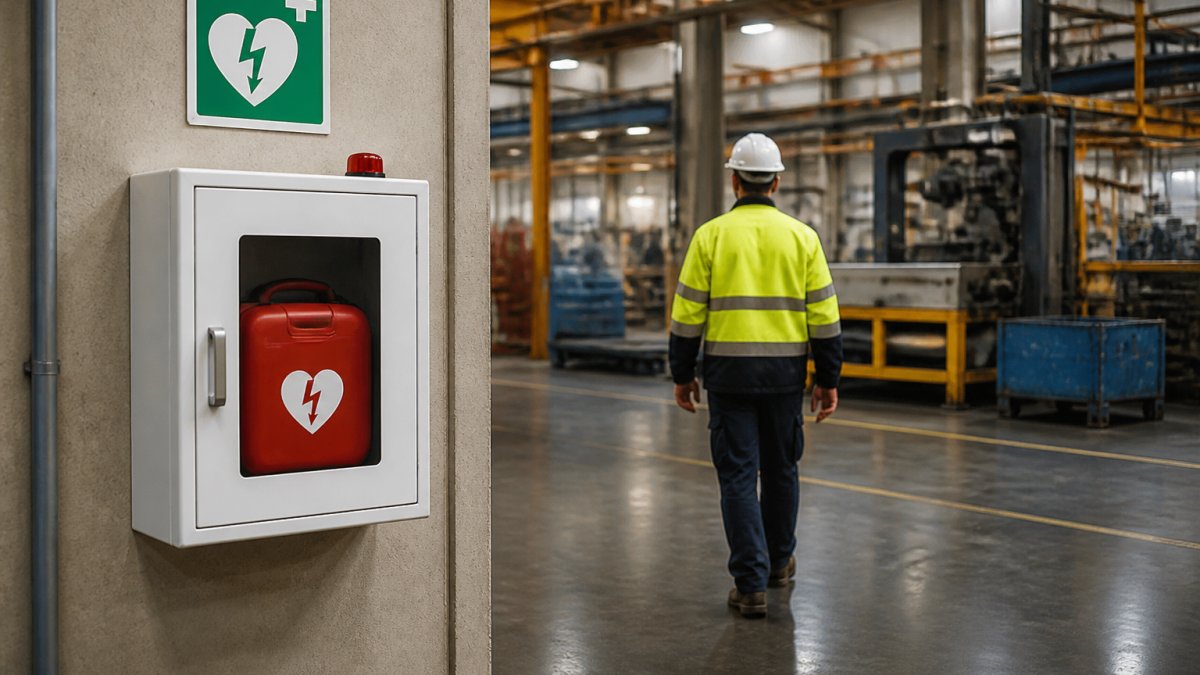
Wall-mounted AED cabinet with safety signage on a busy factory floor with a worker passing by industrial machinery.
Work out how many units you need
One method to consider:
- Draw the site to scale and mark every work area, not just buildings, yards, loading docks, tank farms, remote substations and contractor compounds included.
- Mark the likely collapse points. These are where people actually work and where exertion, heat or lone working raises risk, not the front office.
- Set a target retrieval time. A common planning assumption is that a rescuer should be able to retrieve a device and return within a few minutes, accounting for stairs, doors, PPE donning and the fact that the rescuer may be running. Confirm the target with your first-aid and emergency response leads rather than adopting a number blindly.
- Test it by walking the route. Time the worst-case retrieval from the furthest point in each zone, at shift change when corridors and walkways are busiest.
- Add units where the walk fails. Split the zone, relocate the cabinet, or add a second unit at a satellite first-aid point.
Place each unit where it will be found and reached
- At designated first-aid points. Consider where people may look for emergency equipment when planning AED placement.
- On the main travel route, not in a back room. Consider access to the device when choosing its location.
- At entrances and stairwells. Consider how staff and visitors will locate the device.
- Consider access control. Consider access controls when choosing a device location.
- Protect it from the environment. Consider the surrounding conditions when choosing a device location.
Signage and registration
Consider how staff and visitors will identify the device and its location.
Remote monitoring changes the placement maths
The LIFEPAK CR2 cprINSIGHT Wi-Fi listing describes wireless connectivity for real-time device status monitoring and remote management, automatic notifications when the AED is used or requires servicing, and accessory expiry notifications. The Mindray C2 listing describes wireless and 4G connectivity options.
AED Battery and Pad Replacement: What It Really Costs
Replacement intervals vary by model. The Defibtech Lifeline listing specifies a seven-year battery standby life. The LIFEPAK CR2 cprINSIGHT Wi-Fi listing specifies a four-year standby battery life and electrode expiry four years from manufacture.
Check the manufacturer's stated expiry information for pads and batteries.
Safe Work Australia guidance on first aid in the workplace sets the expectation that first aid equipment is maintained and accessible.
Your AED Maintenance Checklist for Shift After Shift
Check the product's instructions for maintenance and expiry information.
- Readiness indicator showing green
- Pad expiry date logged and in date
- Battery expiry date logged and in date
- Cabinet unlocked and sign visible
- Monthly check recorded in the log
- Annual service booked
Frequently Asked Questions
Which AED brands are best for manufacturing sites?
The right choice depends on your site conditions and budget. The Mindray C1A is listed at $1,900 and the Mindray C2 at $2,450; both listings specify IP55 protection and 360J capability. The LIFEPAK CR2 Essential semi-automatic model is listed at $2,999.99, and the LIFEPAK CR2 cprINSIGHT Wi-Fi model at $4,145. The cprINSIGHT Wi-Fi listing describes ClearVoice prompts and wireless status monitoring. The Defibtech Lifeline is listed at $2,300 and has a seven-year battery standby life.
Are AEDs suitable for dusty or harsh industrial environments?
The Mindray C1A and C2 listings specify IP55 protection against dust and water. Check the listing for the specific model you are considering.
Where should AEDs be placed in a manufacturing facility?
Consider site layout and access when planning where AEDs may be placed.
How often do AED batteries and pads need replacing?
Replacement information varies by model. The LIFEPAK CR2 cprINSIGHT Wi-Fi listing specifies a four-year standby battery life and electrode expiry four years from manufacture. The Defibtech Lifeline listing specifies a seven-year battery standby life. Check the product listing for expiry information.
Do manufacturing workers need AED training?
The Mindray C2 listing describes its fully automatic model as designed to make intervention straightforward. The LIFEPAK CR2 Essential fully-automatic listing states that its fully automatic configuration delivers a shock without the responder pressing a shock button after the safety prompts.
Keeping a plant compliant is a scheduling problem as much as a purchasing one. PFA Shop supplies AEDs, pads, batteries and cabinets, and we can help you build a replacement schedule that matches your shift roster. Get started with PFA Shop and put a maintained, ready device within reach of every worker on site.
